
There is plenty of information on wrist action in the golf swing, including information here on this blog, but most of it deals with the movement of the left wrist or left side in the golf swing. However, this online golf lesson article and accompanying video are dedicated completely to the movement of the right side throughout the swing, specifically the right wrist action for the perfect golf swing with details on 5 key positions to check. Watch the video then check the article below for more detail and photos of some of these 5 key positions.
Step 1: Right Hand Golf Grip – Accent the Trigger Finger
For the right-handed golfer who desires to strike iron shots with a piercing flight and get a divot after the ball, it is imperative to create the right grip positions and consequent wrist positions. Start with a relatively strong left hand grip in which the “V” of the left hand points to the right shoulder, but place the right hand so it covers the left thumb in a more neutral overall position.
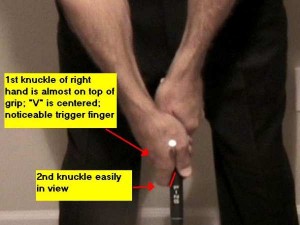
The right hand “V” will point straight up toward the chin, and the secret is accenting the forefinger position so it looks like a “trigger finger.” Going further, be sure the first joint segment of the finger is pressing into the side of the club in a manner that slightly puts the first knuckle on top of the handle as pictured here. The trigger finger will maintain side pressure on the handle from start all the way to impact.
Step 2: Backswing Takeaway – Dorsiflexion Past Right Thigh
The takeaway actually starts with no wrist action at all. It should be a one piece move that is best performed by letting the right shoulder blade begin moving back.
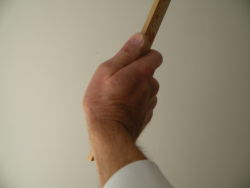
This starts a pulling of the right arm and hand as the club is delivered in a “one-piece” move like handing off a football.
Once the hands move beyond the right thigh, the right wrist will start bending back which is classified as “dorsiflexion.” This bending back of the right wrist creates the corresponding “flat left wrist” that is so well known in golf instruction.
Step 3: Right Arm Folds – Tray of Dishes at Top of Backswing
As the backswing continues to progress beyond the right thigh area and the wrist bends back, the right elbow will start to fold. The right elbow actually does not travel very far in a good backswing. It simply folds and points toward the ground as the right palm faces the sky in the classic “waiters’ tray” position at the top.
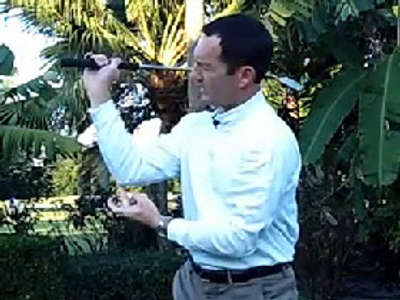
A couple of key points must be noted in this top position. The weight of the shaft should be resting on the trigger finger, not the thumb. Also the right palm will slightly face away from the player to the right. If the opposite is true, club resting on the thumb and palm facing the player, then the clubface will be too open and casting is inevitable on the downswing.
Step 4: Downswing Drops in the Slot with Right Palm Down
As the downswing starts, the right arm and shoulder simply drop straight down as the feet press firmly into the ground and the knees make a slight lateral shift. There is no body turn at this stage – the right arm can’t drop straight down if the chest starts turning.
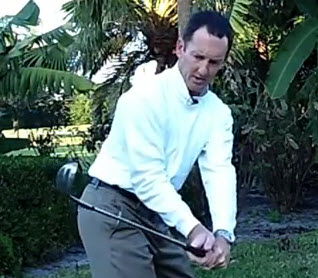
This straight down drop is what stores the lag angle at right elbow and right wrist as the club drops on plane into the slot half way down. The secret at this stage of the swing is to feel the pressure against the right hand trigger finger as the right palm faces down at waist-high. From the top of the backswing it feels like hitting your right thigh with the heel of your right hand while your right wrist stays bent all the way back.
At this waist-high downswing position of the hands, the butt of the club should point at the golf ball, toe of club points upward (but not quite straight up) and right palm is facing the ground, or more technically faces the ball on the ground.
Step 5: Impact and Release in the Golf Swing
Prior to this last step, all efforts have been made to store as much lag and backside pressure on the shaft as possible while keeping the shaft on plane and keeping the clubface square to the swing path. We’re basically at pre-impact just off the right hip with full wrist hinge, right palm down with the shaft hooked by the trigger finger.
Now it’s time to explode. As the hips start to clear and left leg straightens, the right arm will literally unhinge and straighten in a manner similar to driving a nail. Both the right elbow and right wrist straighten. This restores both arms to their full length through the impact zone. If you think about the right arm motion now at its completion, you’ll see the similarity to the nail driving example – grip the hammer squarely for good contact, hinge the wrist and elbow which is our backswing fold, then extend to make solid contact which is our release point.
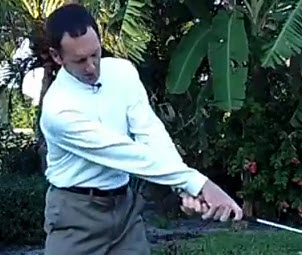
This proper release action requires the right arm to overtake the left arm as it races past and rolls over the left. Hence we describe this as an “overhanded” release in which the right palm continues to face down as it goes past the golf ball. A good image is to try to point the toe of the club at the target as the club exits the impact zone. This sounds like it would hook the ball, but it really works perfectly if you had the proper grip and lag all along.
The result should be a swing which bottoms out beyond the ball with irons to create the proper divot and simply rips the cover off the tee shots with the driver. Watch the video and see if you can get the right wrist action for the perfect golf swing.
Then let me know what you think in the comments section below. Did you pick up more distance, start taking a better divot, kill your slice? Let me know.
I think another good analogy would be the hand positions of a baseball batter waiting for the pitch. When I’m batting, my hands are exactly like you are describing at the top of the golf swing. Well, the bat is not horizontal like in the ‘waiter’s tray’. But pretty similar. Except my left wrist is a little bowed and not straight. Is there anything wrong with a bowed left wrist? And yes, my follow through is short and the club (when I’m doing it right) is pointed straight at the target. I can’t seem to fold my arms over my left shoulder and finish like the pros. I’m always “pointing”. Why can’t I have a nice finish?
Hey Alvin, nothing wrong at all with bowed left wrist … we see it more and more in the modern players. Trevino and maybe Nicklaus to a smaller degree used to be the only ones doing it. Seemed to work pretty well for them.
As to your finish question, it may only be a cosmetic issue but you’ll need that bowed left wrist to soften and “cup” beyond impact to get the club re-hinging back over your left shoulder. If we stick with baseball batting analogies, imagine trying to throw the club behind you over the catchers head so you keep momentum moving well past the ball and through to a full finish. Good luck and thanks for commenting.
Herman: I love your comment about feeling the heel of your right hand hit your right thigh! Every other swing thought about holding the angle in the right wrist doesn’t work for me, but yours does! How did you come up with this??? Thanks, again!
Greg Hill
Outstanding Right Wrist information. I have been looking around and it’s
Hard to find information on the right wrist action. Thank you.
You have a good video about the motion of the trailing wrist which is not discussed very often. Maintaining the bowed back right wrist all the way to impact has always been a problem for me. I gave up golf over 30 years ago, but I still practice almost daily using a camera @ 220 fps. So, I can single step the video all the way to impact and see every error. I take the club back with my left shoulder and just allow my arms to drop while transitioning my weight down into my front foot, and club lag is fine – club is parallel to ground when hands are almost over the ball. But, from there, I start to straighten the right wrist and at impact, the right wrist is dead straight – left wrist is slightly bowed. I’ve tried everything , but to no avail. One of the comments about your video discussed solving this dilemma by rotating his right forearm away from the target prior to impact. But, your video says to rotate the right palm downward toward the ground which seems to make more sense.
Hi Lee, this reply is a little late but if that right wrist wants to straighten early its usually caused by one of only two things assuming your approach path is onplane. If however you are a little steep and outside the plane, you would really have to dip excessively to keep wrist locked in and still hit solid shots. So assuming an onplane downswing: 1) Some players will come into pre-impact with right wrist bent back fully but they don’t really have the face closed enough to face the path line to the ball squarely. They offset this by stalling in some other part of the swing and letting the hands kick forward to square the face and hit a straighter shot. If you think that’s the issue, look at your grip first and then check wrist angle and clubface before impact. 2) The next reason the wrist will kick early is just pure physics … in other words the grip is perfect, the wrist is bent perfectly, the face is squarely facing the path line to the ball coming into impact but some core body component either stalls or rises up and the clubhead starts to outrace the hands and arms. Most Tour players will squat and clear in downswing which helps lower the body enough to get hands ahead of the ball yet still be able to reach the ground and then they thrust up thru impact to help the wrist straighten in time to add a small burst of speed and increase trajectory for a higher shot as the shaft lean starts to unload. In fact the low point for the hands and the handle is at the right thigh area, not impact. If you have this upthrust but think it’s happening too early for you, focus on the sitting/clearing move to get the hips cleared more and give handle time to lower and get a feeling of being effectively past the ball in advance of the upthrust. You need to maintain your spine angle (right sidebend) thru impact as well … if anything the spine angle lowers thru downswing. You can exaggerate by just staying down and clearing with no upthrust from the legs, you will maintain the bend with lots of shaft lean at impact and hit a lower ball, which is nice to know how to do as well. Hope this helps.
Just be careful with this. I was a solid 10 handicap with an outside-in (3-7 degree) swing. I had a decent powerfade with an occasionally slice that got me in trouble but not often. But was allured by the extra 10-30 yards off the tee and the pretty baby draws I saw that my buddies – and most pros – have. Now after 12 months of lessons and practice to achieve an inside-out swing I am basically “lost” and my handicap is up to 15.2. Most rounds I feel like walking off the course. What I have found is that while I have achieved the revised swing path from the top down to the waist (with my arms), I am not able to master the wrist action through the ball. Basically I am so trained to outside in that with the revised swing path I am even more anxious to “catch up” and square the club face. The result is that either I am conscious of this and never release my wrists, leaving a wildly open clubface, or I use the old flipping catchup wrist action at the bottom of the swing resulting in a nasty chunk or hook. All rythm in my swing has disappeared. Just warning all that it is very hard as a outside in lifer to find the correct timing and postioning of the wrists through the ball. I find the backswing and the start of the downswing to actually be quite easy. The worst part is that I am now stuck in no-mans land. After a year and thousands of practice balls I would love to re-find my old outside-in swing, but that seems lost as well.
Golfers such as Vijay Singh and Freddie Couples practically drop their right hand off the club shaft as they approach impact. Reason is the right hand on the club through impact is slowing their golf swing. How should we think about that versus what you said in the video regarding the trigger finger and using the right hand and straightening the right arm to accelerate the club head into impact?
Good observation. These guys actually also have tremendous pressure on trigger finger leading up to the strike. The pressure is being thrown off the finger past the ball for these guys … at that point it makes no difference. Think of the trigger finger as a pressure point on backside of shaft, but it is not hooked around the club in a way that would hold it back if it wants to fly away past the ball.
Herman,
I find this video one of the best golf videos of I’ve ever seen. However, there is one small “pearl” in this video that is not emphasized enough, IMHO. I’m a good golfer, but never understood my early release and poor shaft lean. I’ve tried for years to keep my right wrist bent back, but I was missing something in my hands and knew it. Still had a timed flip. Then I revisited this video, and what you say about the right forearm is what is not discussed anywhere. While it is very hard to keep right wrist bent back on it’s own, it actually becomes very EASY and natural, if one focuses solely on keeping the right forearm turned away from the target deep into the downswing (even just past impact then can release). When I switched my focus on the range to keeping my right forearm turned away from the target deep in the swing, my impact position transformed in one day. Shaft lean, left side lined up, perfection! It was unreal. Of course it was difficult at first, with some chunking due to my hands used to releasing to soon to “catch up the face”. My swing has been transformed. I now watch swings in slo mo (Tiger, Fowler, everyone) and see the right forearm turned away from target deep in the downswing. It is the magic. Why is nobody teaching this?? Only you. Thanks Herman!
Michael
Thanks Michael, I hope you have continued success with your swing. – Herman
” keeping my right forearm turned away from the target deep in the swing” –
Are you saying that you rotate the right forearm clockwise (away from target) just prior to impact to fix the problem ?
tried your rt hand golf swing on practice today its great,i have being trying to figure golf for 8 yrs and was on very dark and confusing mode as of lately, now i see light at the end of golf tunnel will let you know how im doing
Awesome!!! Welcome back to the light. 🙂
Hi Herman, in Step 5 you advocate overhanded release where the right arm rolls over the left but what about players like Jordan Spieth and Lee Westwood who bend their left arms at and through impact thus preserving a square clubface longer? Thanks!
I certainly wouldn’t change what those guys are doing. Generally speaking their technique is a little less powerful, so a distance starved amateur may be leaving a little on the table with the same technique you see in these guys. Anytime you see the “chicken wing” in the left arm it’s difficult to also get forearm rotation until pretty late in the finish. Both of these guys have fairly strong right hand grips by Tour standards and Jordan especially tends to already be a little closed at top of backswing, so no need to get much forearm crossover thru impact. If you’ve got no issues with power generation and find your style looks like theirs, just make sure you aren’t mixing elements from other swing styles that don’t fit together. Good luck.
Herman a question if I may. I have played lots and lots of golf in my lifetime but have a question about my current golf game and swing in particular. Four and a half years ago I quit completely after a partial right hand fusion surgery and have since undergone two full wrist fusion surgeries. Last fall I decided since I love the game so much that I would give it a try one more time even given the fact that my wrist is frozen straight. I have gotten to the point where I can play good enough to enjoy it again but have lately been doing a lot of videotaping of my swing and I have no lag and what amounts to a very early release and a bent left arm at impact. This obviously creates little power (much less than I had pre surgeries) but I can still strike the ball fairly consistently and hit it enough distance to still enjoy the game. Is there anything else I can do to create more speed? I know my impact position wasn’t this way my previous 30 years of playing. Either way as I said, I have learned to swing “around” my issue and can still play well enough to continue. Thanks…
Kenneth
Hi Kenneth, sorry to hear about the wrist issues, but glad you’re still in the game. To be honest, your wrist issue sounds like a deal killer when it comes to creating lag via wrist hinge. You still have a form of lag opportunity at the right elbow, so you likely need to visualize a side-arm hammer blow in which you fold the right arm going back and then fire it back to straighten as it goes through the ball. You are going to get speed by combining rotary speed from your body turn and the leverage of bending and straightening that arm. Some gym time on a cable machine might be helpful where you can strengthen the left arm and left side pulling of triceps, shoulder and lat muscles as well as core turning speed.
Additionally, my experience with players who have somewhat naturally fused right wrists is that they almost always have an open clubface throughout the backswing. This causes them to cast in the downswing to square the face. If you suspect this in your own swing, be prepared to adopt a much stronger than average grip. As you get the face more closed with new grip, you can expect to hook the ball if you are still casting. Then your response should be to turn your body through the shot faster, and you will probably see your left arm start to extend a little better through the ball. “Open-faced-casters” typically slow down their core near impact to wait for the casting to square the face. If this is you currently, just turning faster without addressing the open face will just cause you to end up slicing. Good luck … hope this helps. – Herman
Herman….
Thank you so much for this beautiful explanation of the right hand action. I actually make a conscious effort to go into dorsiflexion on the take-away and this almost feels like a push away move or stiff arm football move. This has given me great extension and makes me rotate my shoulders which then gives me a coiled tension. From there all I can do is to use my lower body to start the swing and I hold on for dear life which is the retention.
Previously when I used the dorsiflexion move, I wasn’t coiling and just mainly swinging my arms. Now with your insights, I see the value of the right hand dorsiflexion move if I combine that with extension-tension-retention. Had no idea I wasn’t coiling enough. Now I’m getting that piercing ball flight even though I’m 67 years old.
Thanks Herman!
Mark
Great description, Mark (I never thought about how similar the stiff-arm move is) … glad it’s working. Herman
AT the top of backswing with my right wrist at 90 my left wrist is some what bowed Should it be flat ?
coming down to the ball should the left wrist be relatively flat before impact ?
Regards
Nick
Hey Nick, there’s no perfect answer for this but slightly bowed can work just fine. Several Tour players from Dustin Johnson to Jon Rahm are bowed. Slightly bowed at impact is ok as well since it will keep your hands in front of shaft. The downside for some player sis they hit the ball lower or may fight hooking if the bowed wrist causes a closed face.
Most handicappers who swing like that will slice it like crazy – they will not be able to square the club face in that short amount of time. There is no lag in golf. As Nicklaus points out – as soon as you shift your weight, you should begin to release the club.
You have to remember what Nicklaus (or any other pro) SAYS they do or did is irrelevant. What the DID is important. Many of the older guys think they did many things but today’s video analysis shows quite the contrary. There is lag in a good golf swing. Clearly evident from video. However, lag is not something done intentionally or with any purpose. Lag is the result of a properly sequenced golf swing involving the body and the arms.
Herman this really helped me with my length and direction.Always had a problem with loosing control of right hand or turning it over too fast (hook). Your tip has helped me to slow my swing down and hit it a ton STRAIGHT!! thank you so much
Training to play on tour and you’ve helped me understand an issue that I was having with a shut clubface at the top and through impact. My path through the ball has been pretty neutral but I have been dealing with the ball turning over a little more than I would desire. And I knew that that was partially due to a shut clubface at the top of my swing. Noticing in the video how the right palm through the transition after the elbow hits the ribs, my clubface was completely shut when my right palm was facing towards the ground. This help me change my grip and see that my grip was too strong and that I needed it to change to have the toe more upright through that Palm facing down position. This gives me a square clubface and I can release through the shot with no fears of the ball pulling to the left but traveling down my target line. Thanks so much checking me out at TimMercer.com .
Thanks, Tim. Great description of the link between clubface and right hand/wrist position in that pre-impact slot position. Right palm down with toe up or slightly tilted down allows you to power through and release with little fear of hook.
Herman thank you. This lesson has helped me a great deal. I am hitting irons with a lot more confidence and have gained a solid club length. The challenge has been the start of downswing without letting my chest turn. I have been reading the step 4 over and over and wish you could elaborate on this step for me. Particularly on “dropping the right arm and shoulder straight down”. What would the hands be doing at this point of the swing? is the left hand pulling the grip down while the right wrist stays bent while the right shoulder is following? I appreciate if you could give me a couple of pointers on this. Thank you
Hey Mike, a little late here with my reply. Hopefully this makes sense. At the start downward, you are basically trying to avoid a helicopter spin of the chest and shoulders which will drive your hands outside the plane line leading to a steep “over-the-top” attack. I would advocate using both hands equally. In other words, if you were pulling down on a rope or a cable machine at the gym, pull equally with both hands and visualize driving them toward your right ankle. Obviously this doesn’t even come close to happening, but our desire to go outward toward the ball tends to cause us to spin and overshoot the proper plane. If you just get a momentary pause of right chest/shoulder moving down versus out, then you can deliver the hit with the hands and arms fairly aggressively. It may help you to see how you can leave the right wrist bent back while still “pulling” down with right arm … your elbow will fall toward your side and your arm will begin to extend at the tricep and elbow, but wrist is last to drive the hit. Much like driving a nail somewhere over beside your right hip.
Hi Herman,
The video is amazing and your concept is very easy to follow and I look forward to practicing the move outlined above. At the top of my backswing (Right-handed), I find that my right elbow points behind to the ground but behind me, should the right elbow be pointed straight down to the ground so that you can form the server’s position with the right palm? Then, I should drop the arms and fire the right shoulder i assume? Thank you!
Pointing behind you is fine. Server’s tray is more of an illustration for feel but not literally possible for most players. It’s not always easy to interpret this in print, but the elbow is too high when the forearm angle is greater than your spine angle. For most of us the right forearm will park at top of backswing in an angle that is parallel to spine angle. In other words, if you are bowed over 20 degrees, then right forearm will also probably be kicked out 20 degrees. There are some long-armed players and super flexible guys on Tour that can achieve a vertical forearm, but it’s a small percentage. Next, yes drop arms and fire right arm/shoulder. Imagine supporting a pizza tray in your hand at the top and then throwing that pizza on the ground just past the ball. Good luck.
Hi Herman,
Awesome video and article– definitely an eye-opener for a beginner like me. I’ve only been playing for two months now, and did not realize (until my new instructor spotted it during our first lesson) that I had actually been cupping the wrong wrist all this time– I’m left-handed with a flat left wrist and significantly cupped right wrist during the backswing. That, plus a few other swing faults, led to all sorts of problems. That lesson led me to search for more information, which fortunately led me to your site.
Anyway, your tips on proper left wrist action, as well as the lateral hip movement as I transition to my downswing, have resulted in some encouraging improvements in my swing. Having said that, I still seem to be inadvertently doing something wrong, particularly with leaving my clubface a bit open on impact (the ball almost always goes straight towards the left), and almost always hitting the ball fat, resulting in considerable loss of distance.
Any ideas on what I’m missing? Wrist hinge not enough, or grip not completely correct? Could it be that my hands are dropping too much prior to straightening the wrist/arms, or perhaps releasing too early? Also, is there a handy marker that I can use as a guide on how far down I should drop my hands prior to straightening the wrists?
Thank you very much!
Jerome, honestly as a 2-month player it’s likely you have more clubhead speed than you can safely control. Nothing wrong with that; it’s just frustrating. I usually find adult males can get decent speed pretty quickly but lack the finer motor movements which help square the face and delay the unhinging at the ball in a timely manner. I will often add some short-iron training using full wrist hinge but very short backswings to help amplify the feeling of maintaining the hinge until almost on top of the ball. Now this kind of swing will leave the face very open again, so then you want to start trying to roll your forearms over at impact as if trying to hook the ball to the right. This sounds controversial to most people because they don’t believe we can learn to time the rotation in the forearms, but it’s more a matter of learning not to leave the face open. After a couple of weeks of this sort of training with a wedge or 9-iron, you can probably forget about it and just swing “normal” with good results. Anyway the goal here is to learn “fast hands” to go with the fuller, faster swings you’ve already been taking. Good luck. – Herman
Hi Herman,
Thank you very much for the quick response! I’ve actually recently added an exercise similar to what you described above to my practice sessions– short backswings with a conscious effort to roll the forearms on the follow through (a tip that I got from another one of your videos, of course!). I do this exercise with a short iron as well as a tennis racket, as the racket seems to make a distinct “swoosh” whenever I do the rolling motion correctly.
I’ve also come across suggestions about the left elbow/arm (for a lefty) being stuck on the left side during transition, which may also contribute to the push shots. When I “lead with the elbow” along with the hip bump, should I drop it more towards the front of my hip, as opposed to the side?
Looking forward to being Hermanized yet again!
Yes, front of hip with the elbow for most players. The exception would be the “one-plane” style swingers who tend to be more rotary with the body. They may let the elbow fall beside the hip and just ride through the shot but you have to turn the hips and chest a bit faster with not so much weight shift.
H E R M A N I S E D
Hi Herman,
Again what a fantastic explanation, simple and consise but with detail that other instructors seem to miss or not explain correctly! It’s tough getting a point across sometimes in the written language with dialogue being misinterpreted so easily at times but you seem to nail it each and every time!
I’ve always arrived at the top with a right elbow behind the seam down the side of my shirt, a straight right wrist and a cupped left, all due to rolling the face open in the takeaway..the only way to get to the ball from there is a stall and flip, which is not ideal for consistency, accuracy or anything really! I’ve had good rounds where the timing has been on and played that way but having tried your takeaway tip my top of backswing position is immediately where I’ve always wanted to be!
I don’t see how I could have missed it, it seems so simple, bend the right wrist backwards and fold at the elbow, voila I’m there! Amazing mate, I can’t wait to get to the range and try it after doing some slow motion work to entrain the movement. Now I’ve seen it work, I trust the motion wholly, now it’s time to get my brain to use that as my primary swing and not revert to my old fanning casting stall swing. Here comes lots of reps but thanks for such an informative and easy to interpret site!
Best regards Herman,
Andy from Down Under land
HI Herman great video on the role of the right wrist, just a quick question. When you get the takeaway past your right thigh and start to bend the right wrist back and flatten the left hand is this motion solely done with the right hand, wrist. Or is the left wrist cocked and puts the right wrist into this position?
Dale, I know you’d like a concise answer, but it’s really a two-handed effort. If you pin me down for a preference, I’ve seen the best results with a more dominant right-hand influence for that “backward bend” and upward break.
What a great video and explanation. After taking the game back up after a few years off, at 61, I found it necessary to change to a one plane centered swing. Previously I had a strong grip and loaded to the right side on a flexed knee, at best a 10 handicap, I always had problems with fat shots/casting and tend to have a very dominant right hand. The new more rotary style swing I let my right knee straighten and let my hips turn, but started hitting high week fades and slices. After watching this video and the one on the grip, it was like a light bulb going off type revelation, especially the explanation of the trigger finger and the right hand positions and release. I practiced the new grip and positions, took to the range and started off with 50% and half shots. The ball compression is great, I was hitting almost as far with 1/2 shots as I did with full shots and my old grip. I almost felt like my right shoulder was stopping for a split second as my right hand hit through the ball and wondered if that is a normal sensation.
Thank you Herman I will be reading everything you write
Thanks, Vic. Great description of what you’re feeling through the ball and yes there is a sense of pausing as the club releases. Basically you’ve accelerated your hips and core, that right shoulder has dropped and then these parts slow down as arms and club explode through the ball. Hope you have continued success.
I previously tried implementing the “trigger finger” technique using a rubber training piece that is attached to the shaft which I purchased from “The Golfing Machine”. However, I’d either pull or duck hook the ball and abandoned it. I tried it again today. Same results.
Is this the same grip that wood be used for the driver and fairway woods?
Yes, you should be able to use the same grip on all of your full swings.
Great tip!!!
Hi Herman,
been reading and thinking about where the power comes from in a golf swing…For a long time I’ve been trying to pull the butt of the club towards the target light you speak about. Which can work great, but also did some reading about if your a righty why would you use your right hand and side to really smack the ball since I’m a righty and I have so much more power in my right side then left. What are you thoughts on using the right side which is the dominant side to hit a golf ball for us righty’s?
Thanks
Ken
Hi Ken, Absolutely use your right side for power. The warning is to be careful if you involve the right side by pushing with your right shoulder outward at the start of downswing. This will cause you to cut across the ball. I describe the start of downswing as being a 2-handed pulling motion on the butt of the club while the right shoulder and elbow lower into the hitting area similar to how you would drop down to skip a rock across a pond or make a sidearm throw. This move typically puts the right elbow right in front of the right hip while wrists and elbow are still fully cocked. Then the right arm shoulder and hip can definitely fire through the ball as if throwing the clubhead at the target.
I’m not sure if your familiar with the Whippy Tempomaster, but their theory was pull with the left lat muscle and leave the rightside completely out of the swing. I will admit it can work especially with a very light grip. But recently I’ve changed to your way of thinking and been driving the butt of the club towards the target and have hit some of the most pure iron shots ever. I’m only 5’4 but still hit my 5 iron around 190-200 But I feel like if I use my right side I can really smack the ball with alot more force. Do pros swing using their right side?
Thanks
Ken
Ben Hogan famously said he wished he had “3 right hands” so I’d say “yes” the pros are definitely using their right side. My best answer is learn to use both sides in concert with each other. There is some good info from ESPN where they did some speed tests on Rory McElroy. they found greater range of movement in his shoulder turn, hip turn, and armswing in addition to moving those body parts faster. If you can pull with left lat, shoulder and arm (left shoulder moves up, back and around) while “throwing” with right shoulder (it moves down, forward, and around) and right arm, you will see a very efficient delivery of speed. good luck.
Hi Herman, where
Great videos. I have a quick question on the right hand heel pad. Where does the right hand heel pad sit on golf shaft. Does it sit on the top of the shaft like the left hand or does it line up on the side of the shaft ?
More on the side. The pocket formed in right palm along the lifeline sits on top of left thumb.
I feel this confirms what I’ve been doing. My problem was activating my triggers to start my backswing and realizing when I reached my top swing. I love the idea of the waiter pose. It reminds me of having my left shoulder reach up to my throat/chin. Id add that the left arm should remain straight and to keep the head still to avoid raising the body trying to reach that waiter pose. Waiters stand upright so it’s something to remain conscious to avoid. Don’t forget to consider ball placement to make sure of proper contact.
Hi Herman,
Really enjoyed this video and been trying to visualize keeping my right palm facing the sky at the top as if I’m holding a tray. What I’m finding is that I’m hitting shots that seem to go straight but fly high. I believe the club face is slightly open but the ball still goes fairly straight. I’m trying to find a piercing right to left trajectory. I struggle with this for sure. Upon reviewing some video, my hands are always in line with the ball at impact and never ahead. Any advice?
Sasha, that is definitely the next step in your training. I usually advocate creating a training drill of sorts in which you take a much shorter backswing that still has full wrist hinge. At this short level, however the right palm is still facing the ground, not the sky. From this hinged position with right palm bent back and facing the ground, you can drive the butt of club past the ball as if trying to smother the shot and deloft it like punching out under a tree limb. The shorter swing basically reduces the time and space you have to throw the clubhead ahead of the hands. If you can start creating shaft lean in this environment, you can gradually start taking larger swings looking for the same impact feel.
Herman, do you have a suggested drill or swing thought that helps high handicappers release the right hand angle on the downswing before impact? In my swing I have found trouble holding the right angle too long, resulting in a slice or shank. Your advice in this article is superb but I am struggling transitioning from theory to application. Thoughts?
Ernesto, the right palm and back of left hand in unison need to rotate toward the ground at mid downswing. Most people fail here and leave the right palm facing the sky too long. When the club is beside your right hip in downswing, your right palm should already be facing the ball – not the sky. As you work on this in slow motion I want you to notice you can still have your right wrist bent back as you rotate it toward the ground. This move is not really unhinging yet. It is simply starting to get the clubface squaring up to the ball. You can get a feel for this by simply clapping your palms together in front of you, and then while keeping palms pressed together bend your wrists so the finger tips are bent back to the right leaving you with the bowed left wrist common to Tour Players at impact. You want to feel that bending and rotation in your mid downswing. Hard to describe in print … hope this helps.
I have been trying to improve my game for many years and I must say, your explanation of the right hand grip, applying pressure on the top of the grip throughout the swing is the best advice I have ever heard. Thank you.
Glad to hear it Ray.
After finally coming off anti-seizure medication which really messes up your perception I found my golf game and really gone south . I was really happy to find your videos about one piece Takeaway .was transformational , it really pointed out some of the mistakes I had picked up .i have allways have always had a one piece take away from taught from One of my first instructors Harry Bannerman when I lived in Europe .
I will be a future follower of yours thank you very much !!!
Excellent, I hope you have continued success and thanks for stopping to comment. – Herman
Your instructions are the best i ever read. My problem is on the downswing. As my rt elbow and arm drops i can maintain the rt wrist break, but my rt elbow always hits my rt side, the elbow never clears the body, resulting in decrease power. I always had trouble with transition and club head lag. If i just forget about lag and transition an use your grip instructions i incresed my distance by 10yds. I know the power of lag, because i felt it once or twice and the distance was incredible. So to sum up my problem, how can i clear rt elbow?
Thank You Lee
Lee, sorry I missed your comment back in December. There are 2 possible directions you can go here. In either scenario it may help to bow over a little more at address and reach out a little more as this will buy you more elbow room and put you a little farther from the ball.
1) First choice is to let the elbow fall on your side as it does now, but clear your body much faster to the target. Literally let the right elbow fall to your right hip area and keep your posture as you clear the hips and chest to the target. Your elbow can just ride your hip right through the ball. Rory McElroy swings this way.
2) Second choice is to make a transition move in which you delay the chest from turning as you drive the right elbow to your belt buckle. In this model you definitely have to bow over and reach more to get that initial elbow room. In the transition, you want to feel like you literally shift your buttocks toward target and away from the ball at the same time. Most golfers let the hips spin too soon and also thrust toward the ball. The right hip ends up in the way of the path you wanted to send your elbow through. So keep your chest facing away from target at top of backswing, bump your butt toward target while keeping posture and aggressively squeeze that elbow toward your right pec as it drops to belt buckle area. You’ll see your elbows get closer together on the way down using this technique. Once that right elbow gets in front of your ribs near your belt buckle just go ahead and release your hips and body to the target completely.
Good luck.
Herman
Herman,
Recently started following your instruction and have to say that your teaching is spot on for me.
The release has always been my problem. I either release early and throw the club head at the ball or hold off release. In one of your videos I believe you touched briefly on ulnar deviation of the left wrist at impact. When you demonstrate the release it looks like there isn’t any UD in your release. Can you explain how UD works and how it should or shouldn’t occur in release.
Thank you!
Ray, most of the UD is a function of physics and momentum which won’t be visible in any slow motion demonstrations. The big key here is don’t flip the right wrist back upward early as if recocking the wrists post impact. The toe of club should stay low as face rotates slightly thru the ball. You’ll notice if you do this in slow motion, the right wrist will be fully arched downward at its maximum range of motion post impact. I encourage students to hit small punch shots with wedges to train this, and the goal is to finish with shaft pointed at target while keeping the clubhead lower than the handle with arms also crossed over. These will be 30 – 50 yard shots using a gap or pitching wedge.
This was a great tip. Not quite as easy to do as it sounds because for some reason for me the UD doesn’t seem to come as naturally from the pure momentum. That must be indicative of something else I am doing wrong. However, this is a great lesson and when I do it right really improves the quality of my iron shots…. as promised.
Hi Herman, how would a stronger right hand grip effect this action. Also should there be a feeling of vertical arm elevation to make sure the club head doesn’t get sucked behind? Thanks
Rodney, in my experience strong right hand grips don’t fit well with the description I’ve presented in this article and video. You can play good golf with a strong right hand, but the strong right hand does not bend back successfully in backswing and requires an underhanded release style that holds the face from rotating thru impact. Zach Johnson is a good example of this style player with a strong grip, closed face, and hold-on style of release
Hi Herman,
Great advice, gooing to hit range tomorrow and try it out, my Palm faces me on top of backswing with club resting on my right thumb, I deform cast but hit the ball pretty well. Will resting the club on my trigger finger make a lot of difference and will it behard to get used to?
Bonjour,
Ce message de France pour vous adresser mes sincères remerciements pour cette video parfaitement explicite. Grace à la correction de mon grip main droite, j’ai pu corriger mon plan de swing qui devient enfin naturel et efficace !
Merci encore
Hello,
This message from France to you my sincere thanks for that perfectly explicit video . Thanks to the correction of my right hand grip , I could correct my swing plane that finally becomes natural and efficient !
thank you again
Laurent
Hi just found your site realy impressed , Ian a single figure golfer (6) 62 years old and loosing flexibility in my right wrist ( ocupational ) do you have a technique to allow for the the right palm that can’t point up at the top many thanks John
John, when you can’t get that flexion in the right wrist, you need to adopt a stronger than average grip with both hands sitting farther to the right on the club for a right-handed golfer. Then don’t expect to do anything with that right palm position at the top … in fact this “right wrist action” video will not really apply to you as a result of new grip and limited wrist bend.
Is it possible to practice these positions starting at the top of the backswing using the pump drill? Meaning, start at the top, move down to pre impact, back to the top again and release? Im having difficulty trying to make sure I have all the positions correct.
Absolutely … that will work perfectly.
Wow. I had an especially strong right hand grip. Felt really weird at first with the practice swings. But even my first shot felt effortless and dead straight. Love the new grip and feeling of club resting on first knuckle.
I’ve spent the last three months changing my golf swing,i’ve always swing just like what you showed in the video the only problem I had was a strong grip so my misses were left. Everyone told me I was to closed at the top. I kept my left hand strong and put my right hand on top just like you showed, unbelievable!!! Its working great can’t wait to go play!!!
Glad to hear it, Neal. I hope those hooks are gone for good.
Hi Herman, thanks a lot for this ‘revelation’! It really puts the focus where it needs to be: on the core issues of the right hand action. Most of the other controls are really secondary, and it may mean re-visiting some previous instructions…
Regards,
Ernst Bode Australia
Thanks Ernst. It is amazing how placement of the right hand can make such a difference for so many golfers that struggle with what the “golf books” have always suggested was correct.
I’m Back, Herman! After limited success with working with an online instructor who advocates a no wrist cock, body release, I realize that doesn’t work for me. I’m severely right hand dominant. Your video about dorsiflexing the right wrist at waist high in the backswing & then “Wiping” the ball with the right hand in the downswing has really helped me get some power & distance back & much better contact with divots after the ball! Is it “OK” to use this thought even on short pitches, basically everything except sand shots where I key on keeping the right palm facing “Up” throughout the swing? Thanks for all your help, I’m Staying With You!!!
Hey Greg. Welcome back. On the short pitches the “dorsiflexion” takeaway and “wiping the wall” forward swing will pinch the ball solidly but tends to hit it lower. It also tends to remove some of the bounce on your wedges which can lead to an occasional fat shot in these low speed swings. But I do like it for hitting low, driving pitches that skip twice and check up, so it definitely has a place. If you need a higher softer shot, use your bunker technique and avoid leaning the shaft toward the target to engage the bounce on the club. Good luck. – Herman
Hi Herman.
Thanks so much for your reply about when to set my wrists in the backswing and I checked out your blog regarding what the right wrist does.
You have the most imformative and best explained instruction on the internet
take this as a major compliment well deserved.
All the best for 2015
Lee West Turnberry Scotland
Thanks Lee, all the best this year to you as well.
Thanks, Herman, I found this video very helpful. From out of nowhere, I recently hit a bad patch of inconsistency with my irons which I concluded came from poor grip and swinging too fast, resulting in quite a lot of topped shots. I found your emphasis on the role of the right trigger finger and the concept of pressing down into the shot gave me a much clearer simpler swing thought and produced a much clearer compressed strike.
Hey Jim, glad you found the solution you needed … great description of how that trigger finger can aid in compressing the ball. Hope you have a good season here in 2015. – Herman
Thanks Herman! I used to be a single digit handicap but after having kids 5 and 3 years ago my golf game was put on hold. Last year I started to play again but I had lost all power as well as my draw. I tried all different tips last year but to no avail. Luckily I came across your video post and all I can say is thank you!!! Your simple grip advice is exactly what I needed. 🙂 For the first time in a long time I’m hitting pure iron shots, my driver distance is back and I’m really excited to get back on the course. Thanks and I hope you have a great golf year.
All the best,
Jimmy
Awesome, Jimmy. Glad to hear you’re getting your game back!! – Herman
Herman,
I’ve been chasing my swing for years. Single digit back to double Digit?
I never seem to find and keep my swing? I recently have been spending hours/day
( retired) working to find a repeatable good swing. I did it by moving my hand higher on the grip with my trigger finger hooked on the shaft and folding my right arm on the backswing. This was probably dumb luck. I immediately went on line and posted my findings and found your video explaining your swing. It made so much sense and helped my make a couple of adjustments to my new swing.
Thanks! This is the best instruction I have seen and believe me I have been through
tens of thousand of them on line plus taken some useless lessons. The closest is the 4 magic moves by Dante. I believe your concept and instructions completed the missing link. Right now its winter and I’m practicing in doors. Improved my swing speed with consistency with this swing. Be in Fl. for March and will keep you updated after a couple of rounds.
Thanks again,
Walt
Thanks for the update, Walt. Hope you enjoy some good golf in Florida. – Herman
question on the trigger finger of the right hand is it actually separated from the other tree fingers on the right hand. In the video it looks like there is a noticeable gap.
Usually a slight gap exists, but it really depends on hand size and finger length. Short or thick fingers may not create the gap. Part of the secret is having the fingers running at an angle along the club in a spiral wrapping fashion. Do not wrap them around the handle in a fist-like fashion like holding a baseball bat.
I’ve been studying your lesson on the pivot. Can you explain what is going on with the right knee? Does the right knee stay flexed or is it straightening?
Thanks
Ron
Preferably it stays flexed. But a slight straightening is common for most players and should not create any problems as long as the knee doesn’t lock.
Herman
I tried your right wrist action golf swing today. The swing was like everything was in a zone. My iron shots were right on target for the first time in years. I am 72 years old and feel like I can play golf all over again. The article on this swing is excellent. I am going to ask that all of my friends go to your site for their golf swing analysis.
Thank you
Thanks, Wayne. Glad you found my instruction tips helpful … it’s never too late is it? All the best in 2015. – Herman
Can I pre-set the dorsiflexion?? Really working on setting the club and it works wonderfully when I do it!! Also pausing at top to slow things down in my tempo! Works great also when I remember to slow down a bit!! Love the videos and also this blog!!
Steve, preset works fine. just beware for some people this make sit more difficult to stay on plane.
Herman. My release is chicken wing. I feel like I have a soft left elbow at impact. Please give me a good drill to get rid of the chicken wing for ever. Thanks. Kevin g
The top of the backswing and the club moving straight down. Are the hips bumping forward I need to know how to practice this. This is a hard move for me. I’m trying so hard to get this. Let me know a good drill to achieve this. Thanks Kevin g
How do you know if you are over squatting!
I like to to squat at a dress and on the down swing.
The key is being able to get out of the squat. Near impact, your target leg (left leg for right handed golfer) must begin to extend and clear. So the downswing starts with a squat to load the leg, then you must thrust upward out of that position as the lead hip clears. If you don’t have good leg strength and balance then you may not be able to get out of the squat. The squat itself probably should be limited to only an inch or two, just be sure you can “post up” on that target leg. Lastly, some people confuse head dipping with the squat motion. Often an excessive head dip is a change in spine angle, either side-bending back away from target or doing an ab crunch over the ball. The squat should just feel like pressing your feet into the ground as you shift weight onto targetward foot. Hope this helps.
Mr. Williams,
I was tinkering around on the range today trying ONCE AGAIN to stop early release when I started to hold it with dorsiflexion and then releasing at the ball. I was FINALLY hitting the driver on the screws and getting a wonderful divot after the ball with my irons with a pure strike. I came back to research what I discovered and found this video again. I would say your advice is spot on about that and give my testimonial that it works! However, I’m trying to be more of a rotational swinger and feel that your instruction may lean more towards an arms type of swing relying more on timing? I think you even say that the start of the downswing is pulling the arms down then firing through after clearing the hips. I can see how a weaker grip would be needed for that style. However, I was finding that with a stronger grip but getting the arms/hands down passively (not pulling) through body rotation put me in similar position a bit more consistently and I could fire through and extend my right arm exactly as you described and get the ball flight as mentioned. I look at the pros and they all tend to have a stronger grip but still appear to have that dorsiflexion as you discuss. If I make a mistake, it would be firing a fraction too soon (old habit) which causes a pull. I also realized I needed to start my transition a bit slower in order to not lose that dorsiflexion too early. I’m curious if you have any comments or observations about my post. I enjoy your videos and find them helpful.
Hi Jim, good post. You’ve made some good observations. The grip, wrist positions and release description I have used online in the past are definitely targeted at a broad audience with abilities that would be less than those of a Tour player. Aggressive body rotation without close supervision for most amateurs tends to fail more often than not. It’s actually an excellent method but requires a good swing foundation and good understanding of some key principles to avoid coming over the top.
A rotary body style will definitely benefit from a stronger grip and more “closed” face throughout the swing. You would also expect a flatter armswing and generally a posture that would be more bowed over in order to steepen the shoulder turn. These are classic “one plane model” positions. Follow those rules and you should do well. Good luck. – Herman
Herman, I’ve always had a strong right hand grip but thought I’d hit a few balls with a neutral grip as you suggested with the right palm facing away at the top of the swing. This grip really felt bad and I thought there is know way I could hit the ball. Boy, was I surprised at the results. I couldn’t believe how easy it was to strike the ball keeping the the right palm down and away on the downswing. I’m 66 years old and have a 6 handicap. This video will really help my game!!!! Thank you.
Never too late to learn a new trick. 🙂
Hi Herman,
Great video. I just can not seem to get my right wrist to stay bent back at the top of my swing. On video, it looks like I have a slight flying right elbow and that may be the cause. It also may be I am not turning my shoulders enough. Should I feel like the club head is falling behind me to get that right wrist to bend back, almost feeling laid off? I will sign up for an online lesson. When I get that palm down coming into impact, I flush it. Just can’t get that consistent tray at the top.
Thanks Herman! Awesome videos.
Michael
Yes, yes and yes. Turn the shoulders more, get rid of flying elbow and feel the club more laid off. All of these ideas will help you get that right wrist where you want it. Good luck. – Herman
I’m not an actually professional golf pro, but I do have aspirations to become one. I think your video was fantastic. I had to go to the range to try the technique and I notice an immediate improvement in how I was striking the ball. You made me a believer. I will definitely look for more of your videos’. Thank you!
Sincerely
Daniel
Hey Herman! Really love the way you teach. I just found a little problem with this article vs. your grip video. In this article, you’re saying have a strong left hand grip with the V towards the right shoulder, and a neutral right hand. In your grip video, you say have both hands neutral. Am I missing something here? Thanks!
Yeah, you’re right on that one. The grip video is intended to be followed by the video for “flat left wrist” as part of a 3-part series for grip, flat wrist and release. That grip style, which is weaker to more neutral, works well for someone looking for the added control a flat left wrist will provide.
The drawback is you won’t get as much natural wrist hinge this way which may limit power for some players. Ultimately you have choices with the left hand placement depending on how you plan to hinge and release through the other parts of the swing. So for max accuracy, go neutral with flat left wrist at top. For max power go with stronger left grip and slightly cupped left wrist at top of backswing.
Herman,
With the stronger grip and the slightly cupped left wrist at the top of the backswing, what should you “feel” regarding the club shaft pressure on the left thumb? Should you feel the pressure directly in the middle of the thumb pad or should it be more on the medial aspect? I’m just trying to develop a feel for the right position at the top of the swing. BTW this concept of the trigger finger pressure and having the toe of the club hit an object a few feet past the ball yields remarkable results. You are truly an excellent teacher! Also, What would cause a slight “pull?”
Ken, regardless of grip style or wrist position at the top I would always seek feeling the pressure centered on the pad for maximum support when the wrists hinge. The stronger grip should trap more of your heel pad on top of the handle and your thumb should sit on the club at an angle to the shaft. This still allows the thumb pad to sit across the handle in a way that provides full contact on the handle. Note that at top of swing due to swing plane angle, the toe of club is not pointed straight down and conversely the thumb pad is not pointed straight up toward the sky.
Excellent explanation. My swing issues are flat on takeaway w/ a strong right hand grip, path back into ball too inside w/ a closed club face. The resulting ball flight is mostly snap hooks and severe pushes. I like your review of how you load shaft onto the trigger finger in the backswing with a weakened grip where release on forward swing allows you to get through the ball without the dreaded hook. I see the reasoning on why I need to make the changes to my swing and your Right wrist action article has given me some additional checks/actions I need to include with my golf swing. Can you provide some feedback on what what your feeling as you start to take the club away? i.e. start with hands, arms, wrist, shoulders, hips, as well as what you feel when you transition to the downswing. Thank You,
Hi Michael. Glad you found some insights into the grip and trigger finger to help you stop hooking. Actually I think you will get the rest of your answers right here on my site and YouTube channel by looking at my article and video on “How to make a one piece takeaway” and then check out the “Golf Swing Weight Shift” and “Golf Swing Transition.” If you just Google these they should come right up. – Herman
Hello Herman,
Today I just came back to your video about the action of the right hand in golf, one more time (never too many), and I think this is the best video on the internet, and I would like to hightlight some points:
Your language and tips are always (this video tip, but also all other staff on your blog) easy to understand and to the point. But in this video you also gave credit to some other teacher on golf channel, and that shows your personal quality. Congrats.
Some points that are really helpful to me are:
You refer to move your right elbow down. I have made this my transition thought, and it helps me with weight transfer and hip rotation, since I naturally tend to keep my left arm straight.
A secondary transition thought is also yours. Point the butt of the club to the ball at waist height during the downswing.
The action on the right hand on the release help me after transition a lot. My next swing thoughts, after my elbow is close to my ribs is hit it with everything that I have got on my right hand side, while rotating my left arm, and throwing everything, even my right shoulder to the target.
I sincerely like the way you describe the realease, starting from a bent right arm and hand, and finishing in your “clapping released” action.
What I find, on top of your teaching, is that I approach the release with my hip past the target line (pointing left of target), I almost never draw or hook the ball.
Beautiful description Miguel … thanks for adding your comments here. I’m sure they will help others understand this even more. – Herman
Hi Herman
Are you working with any PGA tour players at this time and or Champion players?
Thanks
Jay
No Jay, just regular guys and gals trying to improve their games.
Very good stuff. Accurate description. The palm facing down through impact is big with me.. if that’s not happening I will inevitably flip the club through impact … ugghhhh.
I still have trouble fully releasing post impact (my shaft still gets to vertical on my follow through) but I’m getting more aggressive all the time and getting some great compression on all my clubs. Thanks for the site.
Ned
Thanks, Ned. Glad my golf instruction tips have helped your game.
I’m Back, Herman! After Taking many lessons without improvement, I came back to your site. I thought about setting the right wrist back on itself in the backswing, turning my right hip inside toward the target, & on the downswing “Covering” the ball with my right palm. Wow!!! Much more distance, solid contact, compression, & accuracy! Am I on the right track? Thanks!
Hey Greg. Welcome back … your description sounds perfect. Glad you’re seeing good results already. – Herman
excellent lesson with immediate results. thanks very much.
Glad to hear this helped your swing.
Hi Herman,
This video, especially the part about lag, has helped my swing a great deal – thanks! My biggest problem now is greenside bunkers. Do you change any of these right wrist concepts for shots out of a bunker? Thanks again!
In the bunker it won’t be exactly the same as we are willing to let the face get more open going back. i like to go ahead and let it fan open slightly and hinge behind me on a somewhat flat plane. This allows a nice shallow skimming on the forward swing with the face held open throughout. Should feel like the heel of the club enters the sand first. Hope this helps. – Herman
Thanks for the helpful response. I get most of what you are saying, but just to clarify when you say “fan open” do you mean allowing the wrists to rotate a bit more so that the right palm is facing more towards the sky? Also when you say “swing with the face held open”, does this mean keeping the right palm facing up, rather than down, into impact? This would make another great video topic! Thanks again for your help.
Yes and yes … right palm up throughout the shot. 🙂 (The only time this would not hold true is when you are using an ultra weak right hand grip with a preset open face.)
Hi, Herman
Thanks for this video which is the best tips I ever had in my golf live. About just dropping the shoulder/arm at the beginning of the forward swing and stay is brilliant for me. I am playing my best golf after this video.
Thanks.! Herman.
Glad to hear it … thanks for stopping by and commenting. – Herman
I like this right wrist video. I’ve been trying it and pull hook the woods. Is that because of poor weight shift in the downswing – hanging back?
Assuming you haven’t overdone something that causes the face to be too closed in the backswing it is likely you are casting on the downswing. This unloads the wrist cock too soon and causes the face to close too soon coming down. Look for ways to delay this by holding more lag, shifting targetward and/or clearing the hips faster.
Great video. Have had golf instructors tell me to start the swing by activating the hinge of wrists first which sets the club — then all you have to do is turn. The one piece take away I have been told requires much more timing and athletic ability. You are advocating just the opposite—very confusing to me. Also the downswing only takes a few seconds—how can one practice all the correct positions and swing thoughts and know you are getting them correct???
Hi Thomas. This is a lengthy video in terms of describing the number of things going on in the swing. Also as we are humans and not machines, we need to remain flexible in how we apply things as there will often be more than one way to do it, and each way may be pretty successful for certain people. I recommend trying to look at the list and pick one thing you are not currently doing well and start in on training that part. Begin with slow motion swings, practice swings with no ball and hopefully a mirror. Work on 4 live shots at a time and then go back into your slow motion work. Realize that you may not hit satisfactory shots from just changing one piece. You will need to give it sufficient time and repetition to start becoming a habit before moving on to the next item in your list. Note that each time you add a layer, the ball may react in a new way that may even be unsatisfactory. Try to stay the course and build in layers until you have all the components mentioned in the sequence. At the end of your work, you should see fairly positive ball-striking results. Good luck. – Herman
This series of videos is possibly the best I have yet to come across. I have been struggling for quite a while with lag and taking a divot in front of the ball. Your video series has helped more than anything else I’ve come across. Question: I live in Vancouver, BC where the only practice facilities within an hour of the city (other than the exclusive members only clubs) use artificial mats year-round. Do you have any tips on how to get accurate feedback regarding one’s contact-point, since (obviously) one cannot take a divot on a mat? Since the mats have a tendency to make even fat shots look good, I often worry that by practicing on them I may be doing more harm than good to my game.
Thanks, Evan. I don’t have any real magic secrets for practicing on mats. You are right about their forgiveness, but they can still be beneficial for training as long as your contact is “ball first.” A couple of things I look for are as follows: If the mats are slightly damp in the morning it’s pretty easy to tell where the club is scuffing the surface. Look for the majority of the scuff to be past where you have the ball located. You can even use the edge of your shoe to draw a perpendicular line where the ball would be and visualize striking the mat past the line in practice swings. Also listen closely for the sound of your shots and learn to sense the feel as well. You will get a little more of a “click” when the contact is ball first versus a thud when it’s just the mat. And start noticing the feel of the really good shots … the ball feels lighter and softer. Good luck. – Herman
Herman I still struggle with holding the wrist position on the downswing. Should I be using the muscles in my wrists to prevent the clubhead from getting ahead? Or do I move the rest of my body in such a way as to prevent the clubhead from gathering enough momentum in the first place?
I would do both. Push out with left hand, pull in with the right and use a flowing sequence of movement to have the body “outrun” the clubhead.
Herman thank you for your elegant answer. I haven’t made it to the course yet but I felt it in my first practice swing. This is going to help me a lot.
Not sure why we care that you are a nurse.
Respectfully,
Brandon, garbage man
OK,but did you try pressing down on you right foot at the top of your backswing to facilitate the best rotation of your hip during the downswing?
Hi Herman ,
I find your golf instructions for setting up and achieving the preferred backswing is excellent and concise. However; I do have trouble with all the swing thoughts you give while executing the downswing. As you know the downswing can be clocked in milliseconds which makes it impossible for the mind to remember everything you said and demonstrated in the video about the downswing . For example; the mind at the top of the perfect backswing might think: “Do I shift my weight first to the left or drop my right arm? Umm, was I told to rotate my hips as well?” My point is this; in the video you correctly described exactly what the body does during a perfectly executed downswing but may have mentioned way too many swing thoughts for the average player to remember. I wrote to you before that my one downward swing thought is simply pressing down on my right foot. As an RN by profession I know this action anatomically allows my hips to clear and my right arm to drop automatically which, as you have said, is essential in completing the full forward swing.
In your last reply to me you referred me To Jimmy Ballard. I looked him up. A friend of his, once ask him to write a book about executing the perfect downswing. He quip: “That would be one short book!” You told me that there are many ways to think about doing the same thing. I was hoping you will try my way with regards to the downward swing and let me know what you think about it; good or bad.
Respectfully submitted ,
Thomas Fraser RN
Thomas,
Thanks for commenting. You are correct that I have mentioned several ideas in this video. My intent was not to provide a quick single tip for how to make a swing but rather a very thorough description of that entire movement. Most of the complaints I get about golf instruction in general is that it is not thorough enough and that the player does not know why he is being asked to make a certain movement. Particularly in private lessons, I prefer to give a very detailed analysis of the movement in question along with cause and effect descriptions. And I will likely list several changes that need to be made. However, it will be the player’s responsibility to work through that list one item at a time … master a piece and then move to the next. It is never our intent to be multitasking over several ideas at once. But with no knowledge of the whole puzzle most golfers are reluctant to fully “buy in” to making each change one at a time. The “right foot push off” will certainly be a helpful idea for some of our audience.
Hi Herman,
I have applied this move for years since reading Cotton, Armour, and the lovely book “Live Hands”. However, I have never been able to produce a nice little draw with this grip. I loose the ball sometimes right, but never left. Can I draw the ball with this grip without hitting a “pull draw”?
Thanks much
Hi Todd, Those were great authors and players. I grew up reading Tommy Armour from a book my grandfather had. I think you could draw the ball but ideally you need a swing path that allows for a “push draw” by swinging from the inside while making a fairly strong overhanded release of the face. This is a cool ball flight to achieve but not always worth the effort if you already have a reliable move. Good luck – Herman
Thanks Herman, the way I used to hit it 50 years ago and got away from. Great to get back to this great way of hitting the ball after going through several swing changes.
Terry
Hi Herman,
Thanks for the great tips above. I play golf right handed but I play basketball, soccer, etc left-footed/handed. So, my strong had has always been my left. I’m a scratch golfer but my misses that I always fight is the dreaded “hook” or I’d like to call “snipe-hook” 🙂 I’ve worked hard on trying to neutralize my (left grip) but still struggle hitting it left. It also effects my contact as well, since it feels like I’m holding on so the shots are thin.
Above you mentioned on the right hand the feeling of the knuckle almost covering the “V” and to start the swing with the right shoulder blade? I’ve been used to pushing the club back with my left shoulder (right handed golfer). So, any suggestions on getting rid of that dreaded hook would be great.
Thanks and keep up the great work:)
CJ, if you had video at impact it’s likely your clubhead has passed the hands and the toe is closing. If you can maintain a weak right hand grip and work at getting the butt of club past the ball before the strike, you should eliminate the hook.
Hi Herman,
Thank you so much for your fundamental advice, it really helps. One thing I really struggle with are hooks and shots going left that usually start on line. I pay golf right handed but I’m left side dominant. I pay basketball left-handed and so forth so I feel like I really flip the ball at times or hold on to keep it straight.
So, I love your post above cause I want to be able to release the club more but a little confused on where the right is exactly? Am I really covering that left hand to where my right index finger is almost on top as well? I’m a scratch golfer and would love to get that dreaded hook.
Thanks sooooo much!
Short answer is … yes. But see my other comment on impact position.
Herman, Thank you for more yardage and flat out stinger shots, after watching your right wrist video I had to go down one club! You can feel the club snap at impact and it makes a sound I have becer heard before. Can you use this grip with a driver?
Sure. Obviously the driver ball position should be farther forward. As a result you will not try to keep the shaft leaning forward so much into the ball like you do with an iron.
Very lucid explanations of common swing problems. Can”t wait to try
the shank solution. keep up the good work!
Geez.
I could have used this a year and a half ago when I started playing.
I was watching a guy driving 350yard+ drives the other day.
Actually witnessed him get on in two an a 522 yard par 5. His second shot was 175yard or so….and he hits it with a pitching wedge….a pitching wedge for crying out loud.
I finally watched him swing from the front and realized he was doing what this video talks about with the right wrist. I tried it on my next swing and got the best 6 iron shot ever. I should have been short with the 6iron but instead put it danged near off the back, so I definitely got about 20-30 more yards than I generally have been just adding in this right hand thing.
Ive been wondering where the distance has been. This part of the golf swing seems to be well guarded secret or something. Ive talked to a LOT of instructors and really good golfers and they just say ‘practice’ or something vague that really is no help.
This is a VERY good video and article. Thanks for putting it up.
Nobody hits a PW 175 yards…
It seems unbelievable but here’s a link to a golf outing Jamie put on in the Fall of 2013 warming up with wedges from 165 – 180 yards. http://www.youtube.com/watch?v=DZdSXkcjIYU
Thanks so much for the instruction Herman, love your explanations. Been trying to get this right for almost a year and sadly have learned to hate the game. I’m 41, been playing golf about 20 yrs and my handicap WAS abt 9 (from the whites). I tend to cast the club, but I hit it pretty straight so I shoot decent scores in spite. Been trying to get a more powerful swing and the result is the “shankapottamus” I get a decent lag now in my swing but really struggle with releasing the club and getting the club stuck behind me. I’m almost scared to swing and ready to put the clubs back in the attic. What do you recommend?
Michael look at Part 3 in my shanking video and article. You will need to get the lead wrist bowing into impact with the knuckles of that hand turning down. Also the new lag probably has your trailing elbow digging into your ribs more than the past and may also require a little more elbow room than your old swing. It might help to bow over and reach a little more than old swing. basically it’s easy to get lag with the arms too far away from the body, but we have to keep them crammed up against us as long as possible.
Hi Herman,
I love your videos. Are you familiar with the one-plane swing from the Jim Hardy book series on golf planes. I’ve tried to incorporate your tips in my swing but because i’m a one-planer i can never get the club up to the dish-tray level. Tiger is a one-planer and does it, but I mean he’s Tiger. When I try the dish tray thing it brings my body off the ball and my weight gets stuck on the back foot. But if I bring it closer to a 45 degree angle i can hit more consistent shots but I can’t get the lag that you describe. How should a one-planer go about creating lag?
As long as the wrist is bent in the dish-tray style you’ll be fine. The steepness of the shoulders for a one-planer makes the dishes likely to spill, but it’s more of an idea than a literal reality. In a simplified description, the one-planer really depends on getting the face mildly closed in the backswing and then leaving the arms pinned behind him while turning the body aggressively thru the shot. The lag is not as much at the wrist and elbow but more from leaving the arms behind the body while the body turn generates the speed and delivery. The release is much less pronounced for a one-planer as well … kind of “swing left and hang on” depending on the strength of the grip.
Hi Herman,
Love the video came across it while researching right elbow positioning in backswing. Would you agree that by having the neutral right handed grip and keeping the right elbow pointed down at the top that this automatically gets the right wrist into waiters tray position without having to think about it? I notice when I try to really dorsiflex the wrist at the top that the results can be very good with more lag and greater distance. Or is to much to think about?
Thanks Darren
Thanks Darren. I’ll jokingly tell you after watching golfers do this stuff for over 25 years, there is almost nothing natural about any of it. I would say most people would have the elbow down and might still have to concentrate on making the wrist bend back into the waiters position. Take nothing for granted until it’s been trained long enough to be an automatic habit, and don’t worry that you have to consciously do something that might seem really natural for others. Tour Players have a hard time communicating what they do for this reason. They’ve done it so long they overlook some parts and other parts are so automatic they have forgotten what they feel like.
G’day Herman,
I’m finding your instruction videos simply awsome .. you’re a champion!!!
Can I get your take on this scenario, Herman .. .. I’m a lefty, but right hand dominant .. I slice. I fear that my dominant hand is too powerful for my left hand to release upon?? Do you know of others with a similar problem?
Regards – Pete (Melbourne)
Absolutely. When the dominant hand is the lead hand such as yours you will need to train that arm in isolation for a few seconds before each shot to help it feel the proper rotation to create the release move. Simply hold the club in your right hand with the clubhead on the ground in a setup position. Make a very small backswing of only 2 or 3 feet, then bring the club forward at about the speed of a greenside chip. As you near impact, make sure to scuff the turf as you turn the forearm and clubface a full 90 degrees so the toe of club points to target within just a foot or two past the ball location. You are basically trying to retrain the urge to dominate the swing with that arm using a pulling force and instead teach it how to apply an equal amount of rotation force. To fix a big slice I would try to get the back of the hand turning quick enough to face the right thigh before swinging on to the target. Try it for 10 seconds or so and then step up to play the shot. It will usually hook after doing the drill. Once you have a good feel for it you can gradually back off on the exaggeration. Good luck. – Herman
I found yours website looking for answers for the wrist and hands in the swing. I studied your left wrist video and went out and practiced. In one session I know I picked up yards and good ball flight. Just looked at the right wrist video and will go and practice that. Made change on grip from strong to weak and did not interlock fingers. Like that change. Now if I can just get off the right side everytime things may get right. If I can now get the feel of keeping my wrist cocked and then releasing them that would be awsome,
I use to be a 3 in college but I don’t know if I ever really new what my wrist was suppose to be doing in the swing. I am 64 now and look forward to continuing to learn.
THANKS!
Hi Herman,
I am a 51 year old female that started the game of golf a year ago. My brothers all told me I was crazy to attempt to learn to play golf at 50. I ignored them and took lessons all last summer. As you can imagine I struggled mightily all last season but have been bitten by the golf bug. I live in Northern Michigan so haven’t been on a course in months. I do however have a net in the garage and have been working on my swing over the winter. Just last week my husband suggested I should work on hitting down on the ball. After much reserach on the internet I discovered I needed to get lag into my swing which would result in ball compression. This is when I found your incredible videos. After reviewing several I discovered I wasn’t doing anything close to what you were describing. I have been in the garage working like a crazy person trying to incorporate the movements you describe in this video into my swing and am starting to see results. Of course I don’t get it right too often yet but when I do it is such a beautiful thing. As you indicated, attempting this is not for the timid but I refuse to be beaten by the little white ball and hopefully will prevail to some extent one day. I never could have begun the process without your help. Thanks so much for such a detailed, easy to understand explanation for such a complicated maneuver. I have definitely been Hermanized and will hopefully one day make you proud.
Shelly, that’s awesome. Your story is one reason i love doing this stuff. Hang in there and keep us all posted on how you’re doing. Glad to have you in the “Hermanized” flock. Can’t wait for your brothers to start shelling out when they’re losing bets to you on the course. – Herman
Hi Herman, This “right wrist action” lesson is the best explanation of grip and wrist action I have ever seen (and I’m 62!) I had been struggling with my right hand grip being to strong, and becoming disconnected at the top etc. – never knowing for sure what to do. By making my right hand grip weaker, it fits perfectly, feels comfortable, I know it’s correct now so that give me confidence and allows better hinging for more lag. So thank you!
I also really liked your explanation of the transition. I think Ben Hogans actual “secret” is that I think he said his backswing was not finished until he made the transition to the left side. His club is still going backwards another inch as after he transitions his weight – right?
Ron, you are exactly right. Good luck as you continue perfecting these moves. – Herman
When does the right elbow straighten, Herman? Just before or after impact? Thanks!
After impact.
Hi Heman,
I love your videos. I think your the best YouTube coach. Great work
I really have put in a LOT of work. I’m getting frustrated as I can not get the first move in the transition of holding back my chest as weight goes forward. I continually turn my upper body with my hips at the same time or I fall forward with my shoulders.
I have a rotary style of swing and very connected with upper arms to my body. I’m a 9 handicap but inconsistent.
I also can’t get my right elbow anywhere near my right hip. Could you kindly do a video that covers more of this
Should my arms fall passively on the start of downswing or do I help them. Is there another feel that may help.
You may want to look a little closer at the rotary style and make sure all the elemnets you’re working on fit together. I’ll definitely try to do a video on it. Until then you may be more successful by getting the armswing deeper behind you in the backswing. Then on the downswing you want the right elbow to drop behind your right hip and just ride the rotation of your body to impact. That arm drop probably needs to be active and intentional. Arms will still be pinned to your chest as you turn, but at the same time you are forcing the arms to drop as they ride your chest down.
Hey Herman, great stuff! However, I still need some help. Sometimes I get a bit confused about the Right wrist hinge. Should the heel of the right hand be facing down and pushing down towards ground at beginning of wrist hinge (with forearm facing skyward) or heel facing away from body forearm facing parallel. I tend to close the club face off at impact and take a substantial divot at times.
Thanks for the clarification.
If we’re talking about downswing, I’d say the heel faces out from body and slightly downward too. It’s at a bout a 45-degree angle … not quite facing completely down at the ground.
Herman: Thanks For All Your Help With Our Golf Swings! I Was Working On My Swing, Today, & Realized My Hands Were Coming Apart & My Right Elbow Was Flying Outward At The Beginning Of My Backswing. I Tried To Fold My Right Elbow Inward, Immediately, On The Backswing & This Seemed To Put Me On The Correct Plane On The Backswing & Kept My Right Elbow In Tight To My Body On The Downswing. Started Hitting The Ball Very Crisply. Is This OK For Me To Immediately Fold My Right Elbow? I Know My Swing May Not Be As Wide This Way, But It Seems A Lot More Consistent. Thanks!
I think that should be fine based on the results you are seeing. If it repeats and creates good ball flight, go with it.
Hi Herman,
Very interested to see your video. This ties in with a book I have been reading by Joe Dante, which you may have heard about (4 magic moves in golf). Joe also advocates a backward bend of the right wrist, the waiter position at the top with straight left wrist, a lateral move left on the downswing and a late hit.
You are the only other person I have come across who teaches this way. This makes a lot of sense to me because the position of the club at the top is square and you dont have to think about squaring the clubface on the downswing. Also when you make a first lateral move to the left on the downswing the club automatically drops down into a late hit position and you can then swing as hard as you like through the ball. Thanks.
Steve Betts, Cambridge UK
Thanks Steve. You gave an excellent description of what’s going on.
Hey Herman!
I subscribe to your channel and love your video’s! You, sir, are AWESOME! Such a great teacher! Thank you for the time you spend on this!
As for me, I thought I had a decent game with some unique amateur issues…that is until I started watching your instruction! Now I realize I had a crappy game with common issues! lol 🙂 BUT, since applying several of your techniques…man, I am MUCH better! I feel like I owe you money!!!
I used to crush the driver, but couldnt tell you where it was going to land. Now, I annialate it with pretty decent accuracy! And my long irons…the only good shots I hit came when I had to go 90 degrees left! Serious hooker! But Now, since listening and watching you, I smoked my 3 iron 225 down the pipe twice yesterday to be on in 2 (par 5’s)!!! I’m hitting my 5 200ish. I didnt change much on my short irons or wedges because they were (eh) ok, but I know where to go if that ever changes!!
If I could figure out this putter, I would be a force to be reckoned with! Any chance you can fix that for me too? Again, Thank You! Keep up the great work!
CK, glad you’ve seen the light. I loved your description of your game; it’s funny how many people find out their good shots were mostly luck all those years. 🙂 Glad you’re getting on the right track and thanks for the compliments.
Herman
Herman,
Any chance you have some instruction on reading greens? I have pretty decent speed and feel, but I know I am not reading the breaks well. Any useful tip would be great!
Thanks again for all the swing instruction. You have definitely helped me, and now my wife is watching and practicing too! I’m pretty sure I owe you $$….she wants me to take her golfing more and more… Like I needed another excuse! Ha 🙂 You da man!
CK
Herman,
I am signing in as anonymous just in case my betting partners do a search on my name and find my game changing tip that I got from your video. . We just played C Cat at Orange County National, a tough track to say the least. I hit 16 fairways and 16 greens and won a bunch of cash. The tip of you explaining of keeping the hand facing away on the downswing has changed everything for me. I had gotten into the bad habit of turning my right hand and wrist underneath to start the downswing and the results were either blocked shots or flipped hooks. This has been going on for years and countless lessons and turmoil. I saw your video right before I went out at Orange County National and the hit the range 2 hours before tee time and I just crushed the ball on the range working on the hand facing away as I started the downswing. I took the swing on the course and the confidence in the swing just got stronger and stronger. I have been out 6 times on the range after the round and validated my swing every time. I am just ripping the ball, feeling more on top of the ball and there are no more blocks and flip hooks. I am sorry I cannot give you kudos to my buddies as they are dog eat dog bunch and I need every advantage I can get. Thanks again. Anonymous and back enjoying the game.
I love it. You keep taking their cash; we’ll keep it our secret. 🙂
Herman
Hi Herman,
Just wanted to say I think your video golf lessons are great I have definitely been Hermanized.
thanks
Brian UK
Thanks, Brian … glad to have you on board. Good luck in the New Year.
Herman
Herman I real like your video tip. I have problem coming over the top think this might help me.
Hi Herman,
Excellent article.
Can you advise how close the right hand should be to the thigh when club parallel to ground? Also, how straight should the right arm be at the same position in downswing?
Thanks!
Right hand is probably 4-6″ or so from right leg, but the right forearm/elbow will be completely against the body in the downswing. Right arm will still have a lot of flex left at the elbow, sometimes almost 90 degrees. This is possible only by lowering the right shoulder as if dropping into a sidearm throwing position similar to skipping a rock across a pond. Good luck. Hope this helps. Herman
Thanks Herman,
Is the idea with the heel of right hand hitting thigh on downswing to get the hands back to the same position they were at address when looking DTL. That is, the same distance from the body that they were at address. Is such a hand position a good one to strive for at impact? Cheers, Andrew
Andrew, that’s a great way to look at it, but it is meant to be an exaggeration to prevent other problems from occurring. Centrifugal force tends to drive the hands outward away from the body and we instinctively pull back and uncock the wrists as well. Definitely try to do what you described with the heel of the hand, but in the real world the hands will actually arrive at impact a little higher than where they started out and probably a little farther from your body. Thanks for stopping by. – Herman
Work on the grip and setup along with this tip……. pleasantly surprised with the ease and comfort of the grip and the setup is easy to work in. This right hand tip…..all I can say is Wow !!! Big difference…. Crisp iron shots and hit about 5 drives….flew a couple almost past where my normal drives finish.
Good stuff, Herman…..
Thanks,
The Hermanator
Hi Herman,
This is Erik all the way from the Netherlands. I want to compliment you with your online lessons. I have seen many pro’s on the net with quick fixed video lessons telling us how it should be done, but not one is getting close to you. Your detailed lessons are helping me getting better but also enjoying the game more and more. Your lesson on over the top is an eye opener for me and helps me understand (finally) to fix this problem.
Thanks and keep on going bringing those great tips and lessons.
Erik (The Netherlands)
Thanks Erik. I’ll be working on some new videos now that we are finally entering the winter off-season and I get a little more time to devote to the online instruction.
I have been working on your lesson now for about two weeks and just couldn’t get comfortable with what my right side was doing on the downswing and through impact. The comment to another on your link about imagining painting a line on a wall behind yourself with your right hand on the down swing did the trick. thanks Herman
Glad you found that tip. It has worked for many others in my private lessons.
At the range yesterday, tried your neutral grip, keeping left wrist flat and making sure right forearm rotates through impact. I used all my wedges, 7 iron and driver. It was a windy day so direction was difficult but the contact of the face on the wall was different from anything I have felt before – and more distance !
Excellent videos, clearly explained, – this could have changed my game forever !
(17 handicap – Lancaster UK)
Many thanks
Glad to hear it. Sounds like you’ve been Hermanized. 🙂
Hi Mike,
If I have a stronger left hand grip is there a proper place for that knuckle on the grip or does it still go on top? Also if you have a strong grip and a slightly cupped position on the top will the knuckles down help or hurt to square the face at impact?
Thanks,
JP
Strong left hand is ok, but unlikely to require anything different with the right hand. Go as described in video with right trigger finger exposed and knuckle in view. (I assume that is what you meant.)
At impact you probably can’t afford to turn the knuckles down without hooking. Simply try to keep the hands pressed forward at impact out in front of the clubhead.
First class instruction. I have an offending right hand just like all baseball players. This video taught me what a well-behaved right hand does.
Thanks, Steve. Glad to help. – Herman
Thank you, been playing for a year thinking about ebaying the clubs. I took your advice and just hit 50 of the most sweet shots i have ever hit, looks like e bay will have to wait. Thanks dude, Matt, Suffolk, UK.
Glad you found us and avoided losing your game to Ebay. Keep it going. – Herman
Thank you – for your clear description and honesty! Superb advice – you are a knowledgeable golfer and a great teacher!
Herman………good stuff! Watching your video’s has me Hermanized….. or call me a Hermanator. I have been around golf for a very long time and have seen or heard a lot of different instructors and instruction….. you have the gift of maybe the clearest instruction I have seen. Thanks!
Mark E from Tennessee
Thanks, Mark. I try to call it as I see it and give you guys the plainest possible way to understand and fix or build a golf swing. I’m glad you’ve found it helpful. Keep in touch. – Hermanator 🙂
Hi Hermann,
might be your very german first name …..;-)
….but after 4.786.312 Golf videos, 286,145 books and 3.788 DVDs (at least it feels like that) and more than 2.000 $ in Pro Lessons (this is really true) YOU MADE IT and I now -for the first time ever- I know how the trailing wrist works, -and I am already a 18 hcp. after I started golf 2011 in April.
I always knew that my body was doing right but there was a missing link in my release, that stopped me from being more consistant and better.
I was so focused on the front wrist, because everybody is talking about, and here you tell anything thats important.
Had 120 balls on the range to get use to this “new” wrist motion, went out on our 9 hole course, shot a 4 over par and was so excited that I also played our 18 hole course with 11 over par (38 putts*argh*).
I just gained 1 club length and my drives are about 30 mtrs (40 yds) longer in total.
THAAAAAAAAAAAAAAAAANK YOUUUUUUUUU!!!!
I guess Germany is a little too far for lessons, right….;-)?!
Thx so much!!!
Markus, I loved your story. Thanks so much for the honest compliments and testimonial. – Herman
Great video. I am trying to get back into golf after 20 years at age 62. Your three part video describes all of the problems I had 20 years ago. Thanks to you, I understand the mechanics of the swing a lot better. My challenge now is to execute, especially when I have a ball in front of me.
This video seems like a “part four” of the series. I can feel myself rushing my swing at the point of contact and flipping my wrists as I hit the ball throwing my weight onto my back leg often coming out of my stance and lifting my head just after contact. Video three’s recommendations on the left hand made a lot of sense to me, but this video will help me to control the longer clubs at the top where a lot of my problems begin.
Thank you. Your videos are by far the most clear and concise. I wish you would do some on chipping and pitching.
Thanks, Ron. Welcome back to the game after 20 years. I hope it keeps getting better.
Nicely done! Hand position is so important and the way you completely convey how the hands should feel throughout the swing is an overlooked approach to teaching… your perspective reminds me of a great teacher I had as a kid who actually learned to teach from the great Tommy Armour (I). I had lost my way in terms of what my hands should be doing and where they should be but you’ve put my back on track. Thanks so much! One of these days I will have to take a trip to NC (live in Carlsbad, CA) and get a lesson from you.
Keep up the great work.
Ned
Thanks, Ned. I appreciate the compliment. I actually learned the swing as a 12-year old kid by reading Tommy Armour’s book, “How to Play the Best Golf of Your Life.” I would read a little bit and then run down the hill to beat balls for a few hours in the corner of our property trying to figure it all out. Funny how things come full circle. Thanks for reminding me. – Herman
I very much enjoy your training, but I have some issues. I wish I could get you a swing video. The only way I can get my left wrist flat is to allow that separation of the right hand from the palm you warned against. It’s basically for a brief moment only in my fingers with my right hand and my right hand is yanking on the club to bring it back with a flat left wrist. Or as soon as I start my backswing I bow my left wrist horribly so that my watch is facing straight down. Does that make sense? Can you provide thoughts on this. That flat left wrist just feels so unnatural to me, it even hurts to get it In that position, as if it’s forced, well it is, lol. Shots are good and straight and it even feels as if I can create a bit of lag by allowing this separation from the palm. However I just feel confused on the takeaway altogether, I can’t seem to find any videos from top down of the hands during take away, is it a roll or a bow or a hing
I welcome your thoughts
I have to admit i don’t feel comfortable making a recommendation without seeing what is going on. But remember the “flat left wrist” is not the main fundamental in this whole conversation. A square clubface with the leading edge aligned with the left forearm is the primary objective. It just so happens that for most people this works out best when the wrist is flat. So i would go back and double-check clubface position in a mirror at top of swing and also double-check grip to determine if you need to fight so hard to get a flat wrist.
Generally, separation of the hands leads to inconsistency in clubface position in transition and downswing resulting in wild shots. If you are not having a problem, it may be wise to avoid fixing “what ain’t broke” unless you see a big upside payoff to the change. Good luck. – Herman
I’ve noticed that turning my right palm down almost facing the ground on the start of the downswing allows me to hit down on the ball especially with my short irons. Also it seems to allow me create a square clubface early in the downswing. Although turning the right palm down seems counter intuitive it feels like im going to hit a big hook amazingly the clubface
gets squared up. I was having problems slicing prior to this. My right palm was more facing up previously. So my question is i dont feel like i have to rotate my forearms much from my early downswing into impact. And i do feel like the right hand is pushing down.
My question is does it sound like i am overdoing the palm down feel? It feels like a strange new move however it seems to have greatly reduced my slice issues.
I think the golf ball is telling you everything you need to know here. Feels weird ’cause you’ve never done it, but it has to be getting clubface into position better than your old move. If you do finally begin to hook it, then start trying to create more lag and delay the feeling of the “turn down.”
Thanks so much for the video. It confirmed much of what I thought and had been trying, but was unable to find any supporting information. Your explanation clearly cleaned up some of the choices in hand positions which I was not 100% certain of.
Also, I start feeling like I am compressing the ball fully. But, is it also good for driver because u r not compressing ball but hitting in upswing? Please let me know if this works for driver too.
Thanks.
Yes, it works for drivers too. Ball position is obviously different, so you are not hitting down. And hands will not stay in front of club but more likely will be even with the shaft at impact.
I have got all what u have explained so nicely in your video as far as right palm and hand in concerned. It works well. However, I think u have to agree with me that in downswing u have to lift your right heel and push right knee toward target before dropping right hand or palm towards right thigh. Rest will follow byitself. I hope I am right. Otherwise, u will be hanging on back foot and there will not be any weight shift. Rest is as good as u said. Let me know your opinion please.
Thanks a million. U r the best.
Vimal, the move you describe pushing off right instep is fine. Try to do it simultaneously with the drop of the arms. Thanks for commenting and following my articles and videos. – Herman
Great video. Very detailed and informative. I think I am overdoing the drop down and club lag as I end up with a severe slice being unable to square the club head. Im thinking that you have overemphasized the drop down/lag to make the point for the video? Concentrating on swinging inside out and not overdoing the lag helps a lot.
We’re definitely “overemphasizing” lag in this video expecting the audience for this information to be short-hitting casters with no lag. It is certainly possible to have more lag than you can live with and fail to square up the club or create a lot of work for yourself trying to do it. Pick your battles carefully in this sport. But if your right hand grip is good and right palm is facing somewhat downward prior to impact you should not have too much trouble hitting the ball squarely. Good luck and thanks for commenting.
As i stated with the new grip and flat wrist at top of swing i’m hitting my driver the furthest i have hit it in 20 years of playing. It just feels like it allows you to ready smack it hard and square
Ken
I’m off to the range to put it all together, and I’m changing my grip from interlocking to overlapping. Interlocking grip seems to freeze my forearms and make them more tense somehow, the fingers on my right hand are sore, and I have to force my right hand into position on top of the club to get the “V” to point up straight. Now, that can’t be natural.
I’ve also been having trouble getting the right hand in the tray position, the club slips down betwenne thumb and forefinger, no doubt due to my bad grip and lack of forefinger pressure.
Doing it all right is very challenging, but I’ll get there is I just take my time and keep trying.
Thanks for your tremendous work!
Great self-analysis. Good luck with the changes.
Herman
Well, I thought moving to an overlapping grip would need time to improve my shots, before I was blocking and push slicing, now I’m hitting the ball left of center to center already and its easier to get that right hand on top.
I think the interlocking grip was an obstacle to releasing because it bonded the hands together too tightly.
Still some tweaking to do, but I’ll get there sooner or later.
Great video Herman,
I have been struggling a bit with pulling the golf ball and coming over the top. Will working on the right palm facing the sky ‘waiters position’ help with overcoming this problem?
Cheers
Thanks for stopping by Troy … I like your website. This waiters tray won’t necessarily help unless you can feel like you drop the tray straight down (right palm moving toward right hip) on the downswing and then “cover” the ball with it. David Leadbetter once said to imagine holding a pizza at the top and then splatting it on top of the ball at impact. Good luck. – Herman
Hi Herman,
Thanks for the great video as always. The action of the right wrist is something I have been studying in great detail recently. I am a mid-handicapper who has always struggled mightily with an early release. I tend to scoop balls clean off the turf and feel like I have no distance control whatsoever. I KNOW that I need to maintain the lag, but it seems like every time I try to hold off the release until my hands are past the ball, I end up shanking it. I believe this may be due to my right hand “flipping” outward at impact so that my palm is facing the target, rather than the ground, effectively bringing the hosel of the club to the ball. Does that make sense? Is there a drill / training aid that you might recommend for such a problem?
Thanks as always, all my self-diagnoses and countless range sessions with no improvement are starting to wear on me…
Mike, your self-diagnosis sounds pretty accurate. With casting, almost always there is or was a problem with an open clubface lurking somewhere. The scoop/flip is a last-ditch effort at closing the face. So the best thing you can learn is how to have the back of your left hand and right palm already facing down as you approach the ball. Then the face is squared up early and shaft is leaning forward. It’s not always such a big deal to have a maximum amount of lag, just a leaning shaft. Picture a long chip shot with the ball off your back foot and how you should strike it with the shaft leaning forward to keep it low and running. Create the same feel on your way to impact with a full swing, and you’ve got it. Here are 3 checkpoints for right hand.
1) Just past right thigh in takeaway right wrist should be bending back so palm is facing mostly down toward ground. Clubface will look and feel closed.
2) At top of backswing right palm will appear to face away from you to the right like waving to someone off your right shoulder.
3) At waist-high on downswing wrists are still fully bent back but right palm is largely facing the ground again with clubface in slightly closed appearance. Now you only have to finish driving your hands forward and turning the hips to get to impact.
Herman,
I just started watching your videos and after many years and many different swings, i think you explain it perfectly. I know focused on the flat left wrist and was always an over the top player. I was still able to shoot low 80’s at times, but was very inconsistant. I could never get the club to come from the inside. i think using your swing thought of laying the club on a table behind you is really working for me. I also now feel what a real release thru the ball feels like, that flat left wrist helps so much at top of swing.
Thanks
ken
sudeenly, I can’t get your tube videos. best explaination of golf swing I have seen, period. clears up a lot of misunderstandings
CAN YOU APPLY THE SAME TECHNIQUES TO A DRIVER OR A WOOD OFF THE FAIRWAY. I DON’T HIT THE BALL VERY FAR NOW (AGE) AND ANY
HELP FROM YOU WOULD BE MOST APPRECIATED.
THANKS
GREAT VIDEO AND THANKS. CAN THIS SAME METHOD BE
USED FOR A DRIVER OR FAIRWAY WOODS?
Absolutely … just be sure your ball position is good.
One of the best golf instruction videos period. Went and played yesterday with the grip, and while it was different for me, I could really see how it would benefit my game. I appreciate all the time put into this video and how well you know the swing. This was an aspect I knew I needed help with and really feel like I got it here. My one question is on the downswing when you are going from having the right under the club at the top to on top of the club at waist down, how do you maintain the lag? I worked on this for a while and couldn’t really get it. I could feel the pressure of the trigger but was having a hard time maintaining the angle. Thanks.
Imagine your right hand painting a stripe down a wall with your palm facing the wall to your right in the downswing. Just keep your wrist bent back, fingertips to the sky.
Then go look at this article and video https://www.hermanwilliamsgolf.com/golf-lag-stop-casting-lag-like-tiger-woods/. Good luck. – Herman
Nice tip – painting a stripe down a wall. I would tend to get the back of my upper arm into my side on the downswing, which would have my right palm facing up to much when i was coming into the ball. Anyway it helped me quite a bit. Thanks
Herman:
Thank you for your videos.You have helped me in understanding the golf swing.I do need clarification on the part swinging the arms has in the overall golf swing.
In the back swing the arms are swung to waist height. After this the upper body is used to complete the back swing and the arms are passive eccept for breaking the wrists.
The down swing starts with the lower body with the arms remaining passive.When does swinging the arms on the down swing start? Is at waist height or until just before the impact zone
Thank David Maggs
David,
Thanks for commenting and following the videos. Your description is pretty accurate, but I’m not necessarily passive at swinging the arms down in the downswing. Tour Players often fight being too aggressive with hands and arms, but most of my amateur clients are the reverse. They often need to be aggressive right at the start of downswing at pulling the handle down. Most of my amateur clients bring the chest around too fast which causes casting and over-the-top moves as well. So my answer depends on your style which I have not seen, but …
My typical suggestion is to get into a backswing position with an inward braced right leg, spine leaning away from target, full 90 degree shoulder turn and armswing slightly above right shoulder. Then keep your chest “closed” as you press into down into left foot and inward on right foot. Arms will be driving down aggressively toward right hip while maintaining full wrist hinge.
At this waist high position for the hands, you can really pour on the right side extension and release as hips and chest continue clearing.
Caveats: If you’re a somewhat upright arm swinger, then you must hold your chest back longer and “bump/slide” even more to the left with the hips as you forcefully drive the hands down toward right pants pocket.
If you are a flatter armswing player, you will have the club more behind you in the backswing and will probably be more over the ball with your pivot. As a result, you won’t need as much leftward shift. Simply push into the ground with your left foot and clear your whole body (hips and chest) evenly. Armswing can still be aggressive, since it is likely your stronger hips and legs will outrun the smaller muscles of your hands and arms.
left arm flying wedge/right arm flying wedge
Is this right hand movement also referred to as “laying off the club”?
Not necessarily. It can get more involved, but “laid off at top of backswing” describes a shaft position that points offline to the left of target toward third base for a right-handed golfer. Ideally if the shaft reaches “parallel” at the top of backswing, it should point directly at target.
herman,
i really enjoyed your youtube footage of the masters practice round. i couldnt emagine being at the masters. i watched johnny miller talk about the trigger finger on youtube. he references using that pressure and how john daly exaggerates the seperation of the pointer finger and the middle. its may be worth mentioning.
well great videos and let me know what other tour events you have on youtube
jeremy avila
Jeremy, thanks for checking in and thanks for watching my videos. I didn’t get to see all of Johnny’s presentation, but you’re right about Daly’s forefinger position on the club. His trigger is so exaggerated he’s almost touching the steel on the shaft. The Masters is an annual trip for me, but it’s tough with my schedule to get to other events to get video. So for now, everything I have out there on YouTube is from Augusta, but besides the practice footage there are a number of individual pro’s swings on my YouTube Channel.
Herman,
I liked this lesson and gave it a try at the range, it felt a little off but i’ve been giving it some time to adjust. The ones i did hit were all a slight draw when i did the turn the toe over feeling, when i hold off just a pinch it’s a high straight ball (beautiful). Taking it to the course Friday and will see how it looks, didn’t get to hit driver so no idea about that one yet.
How is the belly putter treating you, we’ll discuss validity of it when you get back, enjoy the vacation!
Good luck … belly putter was awesome. Thanks for checking in. – Herman
Herman,
Great lesson. But I am struggling with the hammering nail concept. When I think about hammering a nail, i think about straight back and forward but isn’t the right hand also going forward?
the picture I want for you is to imagine driving a nail somewhat sidearmed as if you were driving a finishing nail in the baseboard or shoe moulding at the base of a wall.
Herman,
I like your points but they conflict with your three videos on “Get more distance”. I like the stronger grip, it feels better for me. Should I just stick with it?
Thanks, Jon Skowvron
Hey Jon, look a little closer. In both video series we allow for a “strong” left hand. It’s only the right we’re willing to make weaker. The weaker right actually allows you to hinge more by bending in the “dorsiflexion” (back bending) direction. Now just keep it bent back and palm facing down on downswing and you’re in the most powerful possible position. Generally the only time this fails is when a player adopts the weaker right hand but fails to get in the “tray of dishes” position at the top. If you’ve already found success, I wouldn’t worry much. But if you think something is lacking in terms of lag and compression at impact, then give this technique a look.
Ultimately, though you bring up a valuable point. The content I produce is for a wide audience. You guys likely can’t try every training tip I produce. I try to put out pretty main stream stuff, but there is certainly more than one way to succeed at this great game. Just as age, talent and physique vary from player to player, so will the swings. Sample things that fit your style, and ignore those that don’t. Good luck. – Herman
Thanks Herman, as usual another great online lesson. Everything you put online is very practical. BTW you will be happy to know that I shot a 76 from the blue tees at Tobacco Road this weekend. Credit to you for getting my game to another level.
Nice playing … that’s a great score especially for winter golf and thanks for checking in to comment. – Herman
Herman
Another great instruction!
This fits nicely into what we discussed in our last session – going to incorporate this into the practice session today.
Thanks, Deva. Good luck with your training … I’m still soaking up the sun in sunny South Florida, but I hope to see you soon. Herman
Herman, brilliant video, easy to understand, although I’m interested in your advice on the implementation of the concepts you cover in this one. ie. is it best to break each concept down and implement in a sequential fashion, until mastery (or reasonable mastery) or attempt to implement each into your swing at once and wear the pain of a multi-implementational approach!
I see the concepts to be implemented as: dorsiflexion, dropping club down with lateral move whilst maintaining the lag, and then the release. Working on trying to implement these together would be, as you say in the video “not for the faint hearted”. What is your advice on the best approach to implement these concepts, sequential or multi implementation approach.
Regards
Garry Nolan
Smart question. If I think my student is doing none of this correctly, I like to start with perfect grip, then the release. I actually don’t mind over-releasing and hooking. This plants the seeds to allow the drop with lag without blowing the shots dead right. But I must say if the tray of dishes at the top and palm-down position half way down are good, then slicing won’t be such a problem if you dive in and try it all at once.
Anyway, trying everything at once can be done if you’ll spend plenty of time with slow-motion reps and no ball to groove the pattern. Most players manage the grip and the drop but have a hard time getting the palm down and the over-handed release, thus leaving shots to the right.
Thanks again Herman,are you sure you don’t have a video of my swing….
because losing the grip at the top of the back swing sure sounds like me.
Hermanized again….It’s amazing…. watching 4 videos of your golf tips and it corrected years of frustration and not knowing how to correct them.
All the instructors,all the videos and all the hours and you summed it up in 4 videos…… and you have never seen my golf swing.
Thanks again….
My crystal ball is all seeing … 🙂 Thanks for following my videos and commenting on the results. I’m glad to have you in the Hermanized camp.
This is really timely. I was just trying to explain the position of the right hand to my son this past week while we were hitting balls at the Golf Academy. Thanks.
Glad to help … keep him practicing. – Herman
Hi Herman,
Great video and explained so well. I think many instructors do not relate to the recreational golfer’s physical ability. But you address it and give us a great path to follow. Can not wait to try this tomorrow. I am so glad I found your website!
Thanks!
What a great observation. You captured my intent perfectly. I really believe most of the published information you get in golf is explaining to you how a Tour Player is swinging and it’s often too generalized or too advanced.
The Tour Player is operating at a PhD level if we compared it to the education system or an Olympic caliber athlete when we compare to the sports world. The recreational amateur can certainly aspire to reach that level, but don’t start with coaching geared toward that level. Grammar school, then high school, then undergraduate and finally the PhD if you make it that far. Good luck and stay in touch. – Herman
Follow up to my first comment. I went outside to practice swing a little bit with the things in mind from the video. I find that the trigger finger emphasis with V pointing at my chin makes me feel more tension or discomfort in the right thumb part of the hand. It feels uncomfortable. Do I need to just get used to it? It will go away in time. Do size of grips have anything to do with the comfort of doing it properly? I don’t have long fingers but I have a thick thenar eminence and large thumb. Thanks again. Wish you were in CT for live instruction.
Hey Mike, Glad you’ve been able to take advantage of a warmer than average Fall and Winter. I’m curious about the thumb situation. The weaker grip should have the thumb pad sitting off the left side of the handle with only half the pad touching the club. There should be almost no thumb pressure on the club, so it’s unusual to have any thumb problems. In fact Ben Hogan used to practice occasionally with his thumb and pinky finger pointed out in the air off the club to accent how the middle two fingers of the right hand gripped the club with the trigger applying pressure from the side. Just make sure the thumb is not doing any of the hitting and you should be ok. Smaller grips will make for more active hands and wrists if you think that will help.
Kudos to you for the best explanation of where the left hand and trigger finger belong on the grip I have ever seen. I think I forget about the waiter tray position too often, resulting in early release that makes me hit the ground before the ball. I am a sweeper so perhaps the early wrist set and waiters tray position can help prevent it from happening. Can’t wait to apply this tomorrow. Yes, I am still playing up here in CT. Weather has been more golf friendly this year.
Hello Mike,
I have had the same problem of early release and my grip being too tight at the top of the backswing. I get a powerful feeling with my driver on the way down so it works,but I am hitting my irons fat.