Hey, I was on the first tee at Augusta National at 8 am Monday morning to film Tiger Woods return to competitive golf Masters Video Part 1. I saw him warm-up in the short-game area and followed him and Fred Couples over to #1 for the first tee shots of their practice round together. I have a two-part video for you with Part 1 posted below. If you want to see a larger version of the video you can go to my YouTube Channel, find the video then click in the bottom right of the control panel and it will expand to full screen. Hope you enjoy.
Camilo Villegas won with a flat left wrist golf impact position. Do you have it? If you hit shots too high, can’t take a divot or lack distance, then odds are you’re missing out.
If you saw Camilo’s win last weekend, you saw a classic ball striking and shot-making exhibition. He consistently hit punch shots, stingers, and partial knockdowns en route to a great victory in Florida at the Honda Classic. These shots are mandatory on a course like the Honda with tight golf holes, water lined fairways, island greens and windy conditions. Now what’s his secret you ask?
Camilo’s secret to super crisp shots is getting a flat left wrist in the backswing and keeping a flat left wrist golf impact position to “trap” the ball against the turf. It’s especially important in the wind. It actually looks and feels like smothering the ball. But this is not simply hitting down either. It’s all in the forearms and wrists.
You might be thinking, “Herman we already talked about this in your December newsletter with the YouTube Videos on neutral grip and flat left wrist.” And you’re right, but I mostly talked about your position at the very top of the backswing. We need to tell you more about how to get there and then how to deliver the club back to the ball. So let’s dig a little deeper.
First, if you aren’t sure about your grip, click on golf grip first. A weaker grip works better than a strong grip for this technique. Johnny Miller even commented on TV about how Camilo has a slightly weak left hand grip. It allows for aggressive swinging and a powerful golf release if you can keep the back of the hand and forearm flat.
Steps to Getting a Flat Left Wrist Golf Impact Position
(assuming a right-handed golfer)
1) The takeaway starts with a straight back motion of the hands. As the arms and club move back from the ball, the back of the left hand is facing down – don’t roll the arms early. Conversely the back of the right hand moves back facing the sky. Go to about waist-high with this first move. This is known as a one piece takeaway. Note the toe of the club does not point straight up at this position. Contrary to popular belief, the clubface is actually facing down slightly and looks closed. If you are wearing a wrist watch on your left wrist, the watch face is tilted slightly facing the ground. If you can see what time it is at this stage of the backswing, you have rolled your forearms and opened the clubface too soon.
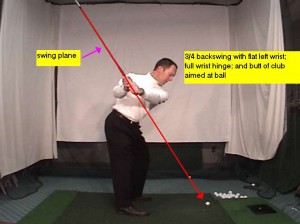
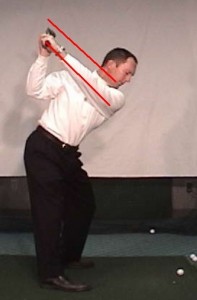
2) Once you pass this waist-high position going back, the left arm starts to rotate like twisting a screwdriver clockwise to tighten a screw with the left hand. The thumbs will start to point behind you. But make sure you wait until the club is at least waist high before you start this arm rotation – this rotation is the move that puts the shaft on plane. As the club begins planing, the butt of club points at ball or more correctly an extension of the target line on the ground behind the ball. See Photo 1: 3/4 backswing position below. Stop the armswing when the left hand is about the height of your right ear or lower if you lack flexibility. The left arm is still straight and pushed well away from the right side of your head. Now your wrist watch will be facing slightly skyward. Left wrist is flat and hinged 90 degrees. See the second photo for a “top of backswing” position.
Photo 1: 3/4 Backswing, flat wrist on planePhoto 2: Top of Backswing - Flat Wrist, On Plane
3) Now for the downswing. Keep your back to the target as the arms start down close to your chest while the hips make a slight lateral shift. As the arms are falling, rotate the back of the left arm down. Remember you are trying to hit with the back of your left hand not the edge of your hand – your watchface is starting to face the ground again. Your right hand must keep up by maintaining the feeling of pressing the handle into the left palm. At impact the knuckles of the left hand should be bowed down slightly toward the ground.
The best way to start training the impact position is to hit little chip, punch shots with a wedge keeping the left hand flat the whole time. The ball should fly lower than average. These training swings should not get above your waist. Just go straight back keeping the clubface facing the ball, then strike with the back of left hand ahead of the ball at impact. Finish with left wrist flat, clubhead low below the waist and the toe of club pointed at target. This finish is key – if you look good 4 feet past impact, you know your impact position is good too.
Another good golf swing training technique is to strike an impact bag stuffed with old shirts and sweaters. The shaft should be leaning forward with the hands past the clubhead when you contact the bag. A second impact bag training technique I like is to put the bag about 2 or 3 feet in front of the impact position down the fairway toward the target. As you swing, you should still be able to strike the bag, but since the bag is down the fairway a bit, the toe of the club should be pointing straight into the side of the bag instead of the flat edge of clubface. This teaches you to release the clubhead, extend the arms to reach the bag and keep the left wrist flat past impact. Remember, because the bag is down the fairway the clubface should have turned so the toe of the club is poking straight into the side of the impact bag.
OK – you’ve now been Hermanized with the grip, flat left wrist and golf impact position tricks Camilo Villegas used in his recent win. This article has been updated to include video on how to get a flat wrist at impact.
The proper golf grip, specifically how to grip a golf club is an often overlooked detail as golfers tend to be far too interested in the complexity of the swing itself. However, a correct golf grip has everything to do with how the swing will develop including the motion of the arms and wrists, clubface control, lag and release.
It could be a separate article unto itself, but suffice it to say that extreme grip errors lead to extreme swing errors. A “weak” grip, in which a right-handed golfer has the hands set too far around to the left on the club, will lead to an open clubface, an over-the-top downswing, casting and scooping at impact and generally high ball flight with slicing and lack of power. On the other hand, a strong grip in which the right-handed golfer has the hands situated too far to the right around the handle, will lead to an unusually flat downswing with severe in-to-out swing path, duck hooks, straight blocks to the right and generally lower ball flight with longer than average distance on short irons.
If these errors and ball flight problems sound too familiar, keep reading to learn what the “neutral” grip should look like before investing too much effort in swing changes.
The Neutral Golf Grip
Step one is to attach and properly position the lead hand to the golf club. Get a club and sole it as it would sit in the playing position, but do this beside your lead leg, or left leg for a right-handed golfer. Standing at attention with the club resting beside the left leg, position it so the shaft is right against the leg, clubface is aimed at target and clubhead soled flat on the ground. With the handle positioned just behind the left hip, reach down and grasp it so the handle runs through the middle joint of the left forefinger then back along the base of the pinky finger while being pinched under the heel pad of left palm. Starting this way ensures that the handle will run diagonally through the hand causing the fingers to wrap in a spiral fashion around the club – note this is different than the way we grip a baseball bat which is held in the fist with the fingers wrapped perpendicularly to the handle vs. the spiral, diagonal wrapping of the fingers on a golf club.
The left thumb should sit at about 1 o’clock, or slightly right of center when looking straight down the topside of the handle. The heel pad of the left palm should be sitting up on top of and across the handle so the handle is trapped under the meaty pad of the hand. No space should be visible around the pinky finger – it should be clinched snugly around the handle. The thumb should be retracted up into a “short-thumb” position which forms a tight seam between thumb and forefinger creating the classic upside down “V” referred to in so many golf instruction manuals.
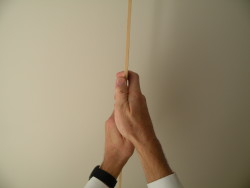
Step two is to lift the golf club around in front of the body and check the left hand position. Lift the club so it extends straight out horizontally to the ground out in front of the belt buckle with the leading edge of the clubface perfectly vertical or “toe up.” (Click here for setup article and video to see exactly how to position the club for this step.) As you look down at the left hand, the first two knuckles on the back of the hand should be visible. The seam that forms the shape of a “V” should be angled to point toward the right cheek or shoulder area. Try holding a golf tee pinched in the seam of the “V” to use as a pointer. The tee also works great to keep the “V” sealed together so it does not gap open during the swing and cause the club to move in the hands.
Step three is placement of the right hand on the golf club. If you look down at your right hand as it rests naturally at your right side, you will notice it turns slightly inward – palm facing the right thigh or even facing slightly behind you. Humans definitely don’t walk around with the right palm facing up, but they will sure put it on a golf club that way if left unsupervised.
As we already did with the left hand, you can go ahead and pinch a golf tee in the gap between right thumb and forefinger to accent the “V” formed on the right hand as well. As the hand comes to the golf club, it is important to maintain the natural, anatomically-neutral joint alignment you saw when the arm was hanging at the side of the body. Focus on first laying the handle in the crease of the middle two fingers and slide them back until they touch against left forefinger. Allow the right pinky to lay on top of left forefinger – DO NOT INTERLOCK them together. The interlock grip tends to work the right hand too far underneath the club as the player attempts to shove the right pinky and left forefinger all the way together. This inevitably creates a right hand position too far to the right with the palm facing up. This is referred to as a “strong” grip.
Once the right hand is fully attached to the club, the “V” should point straight up at the chin. The lifeline crease in the right palm covers the left thumb, which should be totally covered. A pronounced “trigger” finger is created by the right forefinger. It literally sits on the backside of the handle in the same position it would sit on the frame of a gun to pull the trigger. The right thumb rests on the left side of handle so just the inside edge of the thumb touches the handle. Note the right thumb is not straight down the center and it is worth repeating … only the inside portion of the thumb pad is in contact with the handle.
Final Check. If you look down at the hands from above while holding the club horizontal to the ground in a “toe up” position straight out in front of belt buckle, you should see two knuckles on the back of each hand. Two knuckles showing on each hand suggests a perfectly neutral grip position. The V’s on each hand should be sealed together – left hand V pointing to right cheek or shoulder, right hand V pointing to chin. Conversely, if you were to place the club on the ground behind the ball while assembling the grip and then tried to look at the hands, it would be too difficult to see the correct positions.
With both hands in final position on the club, it should be comfortable to hinge the wrists up and down as though driving a nail with a hammer. That completes the grip by removing any unwanted tension as you prepare to sole the club behind the ball and move into setup position. With a solid setup, good backswing, downswing path and release, you can trust this perfectly neutral grip to be able to deliver the clubface squarely to the golf ball time after time. Try it and leave me a comment to let me know how it worked. Thanks.